Clear Thinking 6 min read
Be Like the Headland
Thinking for yourself in an age built to think for you, with a little help from some very old philosophers
Listen · 6 min
Download for later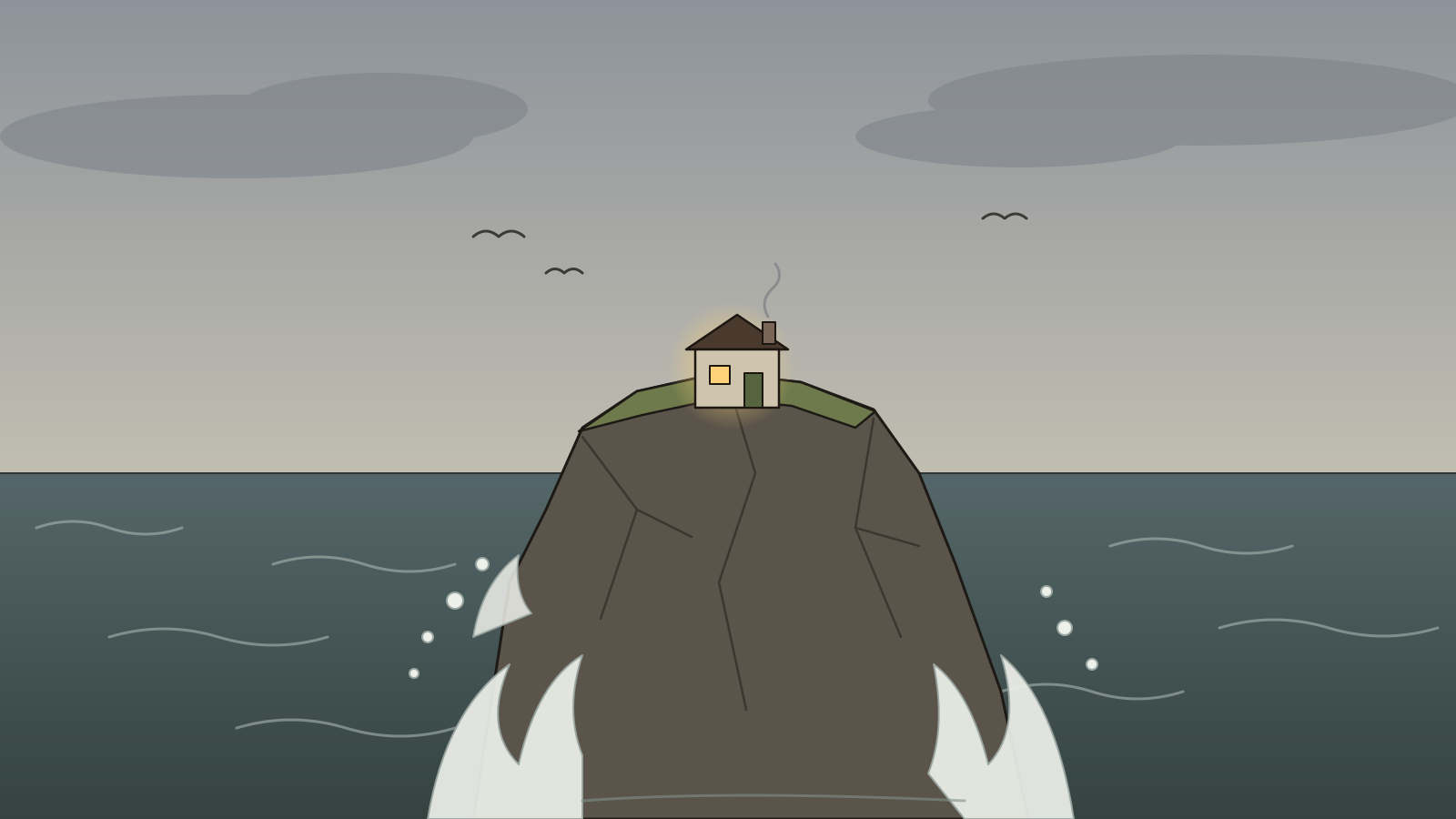
Somewhere in his private notebook, written by candlelight on military campaigns nearly two thousand years ago, the Roman emperor Marcus Aurelius left himself an image. In George Long’s old translation:
Be like the promontory against which the waves continually break, but it stands firm and tames the fury of the water around it.
He wasn’t thinking about advertising or social media. But it’s hard to find a better picture of what a mind needs now. The waves have never been higher.
The water you swim in
It’s worth saying plainly what the modern information world is designed to do, because the design is rarely stated.
Most of the apps on your phone are free because your attention is the product. They earn more the longer you stay and the more often you return, so they are tuned, with great skill and enormous data, to keep you there. The feed is endless on purpose. The notifications arrive unpredictably on purpose, because unpredictable rewards are the most compelling kind, the same principle that keeps a hand on a slot machine. The posts that spread fastest are the ones that provoke the strongest feeling, usually outrage or fear, so that is what rises to the top.
Advertising works by a related set of levers. The psychologist Robert Cialdini spent years cataloguing them in Influence, and once you know them you start seeing them everywhere:
- Scarcity. “Only 2 left.” “Offer ends tonight.” Urgency switches off deliberation.
- Social proof. “Bestseller.” “10,000 people are viewing this.” We assume the crowd knows something.
- Authority. The white coat, the expert badge, the confident voice.
- Liking. We say yes to people who are attractive, familiar, or seem like us.
- Reciprocity. The free sample, the free guide, the small gift that creates a feeling of owing.
- Commitment. A small yes (“just sign up”) that makes the next, bigger yes feel consistent.
None of this is a conspiracy. It’s an industry, operating in the open, and very good at its job. The point isn’t to be afraid of it. The point is to notice that thoughts which feel like yours have often been placed there, and to decide, deliberately, which ones get to stay.
The old discovery: impressions are not facts
The Stoic teacher Epictetus was born a slave and became one of the most influential thinkers in Rome. His central insight is the foundation of mental independence, and it’s very simple.
He divided the world into two parts: what is up to us, and what is not. Our bodies, reputations, possessions and the actions of others are not fully up to us. But our judgements are: what we accept as true, what we desire, what we turn away from.
Things arrive in the mind first as impressions: a headline, an image, a sudden feeling that something is outrageous or essential. The untrained mind assents at once. That’s true. I need that. Those people are terrible. Epictetus taught his students to put a gap there. When a strong impression comes, he said, speak to it, something like:
You are only an impression, and not the thing you appear to be.
Then test it. Ask what it actually is, and whether it concerns anything within your control, before you let it in.
That gap, a breath between the impression and the agreement, is where all freedom of mind lives. Modern psychology says something similar in different language. Daniel Kahneman described a fast, automatic way of thinking and a slow, deliberate one. Persuasion, in almost every form, is the art of reaching the fast one before the slow one wakes up.
Seneca and the crowd
Seneca, a Roman statesman and Stoic, was once asked by a younger friend what he should avoid above all. His answer was a single word: crowds.
He wasn’t being snobbish. He was being honest about himself. Whenever he spent time among the crowd at the games, he wrote, he came home a slightly different man, with some of the order he’d built in himself disturbed, and some of the faults he’d driven out quietly returned. Character, he thought, is contagious, and we catch the moods of the people around us without consent.
He could not have imagined a crowd that fits in your pocket, follows you to bed, and is there before you’ve opened your eyes in the morning. But his advice applies to it more than ever. What you surround your mind with, you slowly become.
A practice for an independent mind
Thinking for yourself isn’t a personality; it’s a set of habits. Here are some that have lasted:
- Pause before agreeing. When something provokes a strong reaction (anger, fear, desire, I must share this) treat the strength of the feeling as a reason to slow down, not speed up.
- Ask who benefits if I believe this. Not cynically, just clearly. Every message has a sender, and most senders want something.
- Choose your crowd. Unfollow freely. Read fewer, better sources. Spend more time with people who make you calmer and wiser, and less with those, online or off, who leave you agitated.
- Read old books. Ideas that have survived two thousand years have been tested by far more minds than this week’s trending opinion. They are also immune to the algorithm.
- Write before you read. In the morning, before the feed, spend ten minutes writing what you think about your day, your work, your life. Your own thoughts deserve to arrive first.
- Argue the other side. Before settling on a view, try to state the opposing case so well that its holders would nod. If you can’t, you don’t yet understand the question.
- Be willing to change your mind. Independence isn’t stubbornness. It’s loyalty to what’s true rather than to what you said yesterday.
A warning about the opposite trap
There’s a counterfeit of independent thinking that is very common today, and it’s worth naming. It’s the belief that whatever the mainstream says must be false, that real truth is always hidden, and that distrusting everyone is the same as thinking for yourself.
It isn’t. That’s simply another crowd, with its own feeds, its own outrage, and its own sellers. The Stoic way isn’t to believe nothing; it’s to test everything, including the things you’d like to be true. Sometimes the expert is right. Sometimes the boring explanation is the real one. A sovereign mind is free to agree as well as to disagree.
The headland doesn’t fight the sea. It doesn’t shout back at the waves or try to stop them coming. It simply stays where it is, rooted in something deeper than the surface, and lets the water break and fall back. That’s the work: not winning every argument with the world, but keeping a small, quiet place in yourself where you decide what’s true.
Sources
- Marcus Aurelius, Meditations, Book 4.49
- Epictetus, Enchiridion, chapter 1; commentary by Jan Garrett, Metaphorical Structure of Epictetus’ Encheiridion 1
- Seneca, Moral Letters to Lucilius, Letter 7, discussed at CiRCE Institute
- Robert Cialdini, Influence: The Psychology of Persuasion (1984); principles summarised at MindTools
- Daniel Kahneman, Thinking, Fast and Slow (2011)