Essentialism 14 min read
The Net and the Arrow
Catching everything you want, choosing the few things that matter, and walking a straight line towards them — with Mark Joyner's Simpleology, Leo Babauta's power of less, and a pencil
Listen · 14 min
Download for later
A man called Bob tells his friend he’s lazy. He sits around half the day, he says. He never gets anything done.
His friend, the writer Mark Joyner, replies: you’re not lazy. I’ll prove it.
Imagine, Joyner says, that you’re standing in front of a dark, creepy maze at dusk. A stranger offers you a million dollars if you can find your way out by dawn, assuming you make it out alive. Do you go in?
Bob says no. He doesn’t know what’s in there. It feels like a trap. He’d rather sit it out.
Now imagine a second maze. Same million dollars. But this one is small and well lit, and you can see the way out from where you’re standing. Do you go in?
Of course you do. Almost everyone does. And in that moment, Joyner says, you’ve proved you aren’t lazy. Laziness would refuse both. What you actually refused was something else: an unclear path, a doubtful outcome, and a risk you couldn’t measure.
In a later post he puts it plainly. We feel energised when we’re confident in the outcome, the reward is high, the risk is low, and we have a clear path. Take away any one of those, and what looks like laziness quietly moves in.
That’s the starting point for this piece. Most of us aren’t short of desire or effort. We want plenty. What we’re short of is clarity: knowing exactly what we want, choosing a few things instead of forty, and seeing a straight path from here to there.
A simple science
Mark Joyner was one of the early pioneers of selling things on the internet, back when e-books and online ads were new. In 2007 he published a book with a deliberately odd title, Simpleology: The Simple Science of Getting What You Want. Around it grew a web app of the same name, which has been running in one form or another ever since; the latest version, Simpleology 6, is still guiding people through it day by day.
His central idea is disarmingly simple. Most of life’s frustration comes from complication: too many goals, fuzzy goals, scattered attention, wasted motion. Strip that away and the path to most things we want is surprisingly short.
He boils it down to five laws. They read almost like physics, and that’s intentional.
- The law of straight lines. The shortest distance between where you are and what you want is a straight line. Most of us zig-zag: side projects, half-starts, detours, commitments that go nowhere. Before any decision, ask: does this move me in a straight line towards what I want?
- The law of clear vision. You can’t walk straight towards something you can’t see. “Get in shape” is a fog. “Walk five kilometres without stopping by spring” is a lighthouse.
- The law of focused attention. Attention is the light you see by. Scatter it across forty tabs and a buzzing phone and you can’t see anything clearly.
- The law of focused energy. A knife cuts because all its force meets the world along one thin edge. The same force spread across the flat of a blade cuts nothing. Effort works the same way.
- The inescapability of action and reaction. You can’t opt out. Not acting is also an action, and it has consequences too: the problem grows, the window closes, the debt compounds, the weeks go. We met this law in Cold Start: while we are postponing, life speeds by.
None of these is new. The archer, the carpenter and the farmer have always known them. What Joyner did was put them in a row and turn them into a daily practice.
The net: catch everything
The first part of the practice is a tool Simpleology calls the Dream Catcher.
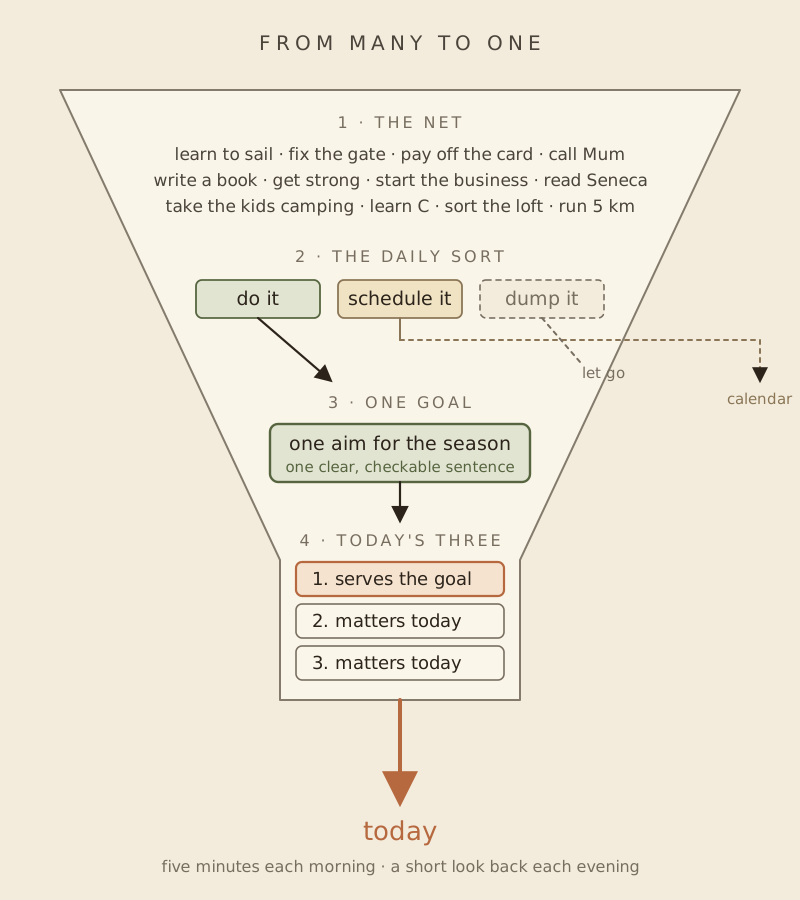
It’s the place where everything goes. Every want, idea, task, worry and half-thought: learn to sail, fix the gate, call Mum, start a business, read Seneca, sort the pension, take the kids camping, lose the belly, build that app. Big and small, noble and boring, all mixed together. You don’t sort them as you catch them. You just catch them, as they come, so they stop circling.
This matters more than it sounds. Your mind can only hold a handful of things at once. Joyner points to the old finding that we can consciously juggle about five to nine items. Everything beyond that doesn’t disappear: it nags. The psychologists E. J. Masicampo and Roy Baumeister found that unfinished goals keep intruding into our thoughts while we try to do other things. But they found something else too: once people made a concrete plan for the goal, the intrusions faded, even though the goal wasn’t yet done. The mind will let go of a thing once it trusts that the thing is held somewhere safe, with a next step attached.
We met the same idea in Unhooked, in David Allen’s line: your mind is for having ideas, not holding them.
So your first act is to cast a wide net. Sit down with a notebook and empty your head. Not a neat list of goals. A brain dump, honest and messy:
- What do you want to have? (A paid-off house, a workshop, a stronger body.)
- What do you want to do? (Run a marathon, sail, write, travel with your children.)
- What do you want to be? (Calm, patient, fit, someone who keeps his word.)
- What do you want to be rid of? (Debt, clutter, a habit, a job, a grudge.)
- What’s been nagging you? (The gate, the tax return, the phone call.)
Keep going past the point of comfort. The last few lines are often the truest.
The sort: three doors
A net full of fish is not a meal. The second part of the practice is sorting what you’ve caught, once a day, quickly.
Simpleology gives every item three exits. In the app they’ve had slightly different names over the years, but the idea never changes:
- Do it. It’s worth doing and it’s for now: it goes on today’s list.
- Schedule it. It’s worth doing, but not today: give it a date, and let it go until then.
- Dump it. Be honest: you’re never going to do it, or it doesn’t matter. Delete it.
The app’s own guide has a lovely line about that last door: liberation is addictive. Crossing off a wish you’ve carried for years, not because you did it but because you finally admitted you don’t want it, is one of the quietest pleasures there is.
If you’ve read Do One Thing Well, you’ll see the shape at once. It’s a little Unix system. The net is a file you append to. The sort is a small program that reads each line and sends it to one of three places: today’s list, the calendar (the computer would call it cron, the clock that runs things later), or the bin (/dev/null, the place where things go to be gone).
The arrow: choose a few
Here’s where most systems fail. They help you catch and sort, and then they let you keep sixty things on the “do it” pile. The pile becomes a guilt list, and the guilt list becomes another chain.
This is where Leo Babauta comes in.
In November 2005, Babauta was a father of six on the island of Guam: overweight, in debt, smoking, and, by his own account, unhappy with how things were going. He’d tried to quit smoking before and failed. This time he did one thing differently: he did only that. Once it held, he took up running. Once that held, he changed how he ate. Then he got his finances in order and paid off his debts. He ran a marathon. He started a small blog called Zen Habits, which became one of the most widely read blogs on simplicity in the world, and wrote a book called The Power of Less.
His method, the whole of it, is in the title. Limits. Not as a sacrifice, but as the engine:
- One goal at a time. Pick one goal for the next six months to a year. Break it into this month’s piece and this week’s piece. Take one small action towards it every day, first thing.
- One habit at a time. A single new habit per month, small enough to be easy, done every day for thirty days. Tell people. Report back.
- Three projects, at most. Everything else waits on a list until one of the three is finished.
- Three Most Important Tasks a day. Write down three things that would make today a good day, with at least one of them serving your one goal. Do them first, before email, before the news, before the world gets its hands on your morning.
Notice how this fits Joyner’s laws. One goal is clear vision. Three tasks is focused attention. Doing the goal-task first thing is focused energy, applied to the edge of the day while it’s sharpest. And the whole thing walks a straight line.
There’s a question, from another writer on focus, that makes the choosing easier. Look at everything in your net and ask: what’s the one thing I could do such that, by doing it, everything else would be easier or unnecessary? Often there is one. Paying off the debt makes a dozen other wishes possible. Getting fit makes everything else lighter. Learning one skill opens the door to the business. That one thing is your arrow.
Make the target visible
Once you’ve chosen, sharpen it. Joyner’s second law, clear vision, is one of the best-supported findings in all of psychology. Edwin Locke and Gary Latham spent decades studying goals at work, and found again and again that specific, challenging goals led to better performance than being told to do your best. “Do your best” sounds kind, but it gives you nothing to aim at.
So turn the fog into a lighthouse. Write the goal as one sentence that a stranger could check:
- not get fit, but run 5 km without stopping by 1 March;
- not sort out money, but pay off the card by the end of next year;
- not learn C, but finish the book’s exercises and build one small tool I use every day.
Then add Joyner’s other three ingredients, the ones from the maze. For whatever you keep not starting, ask:
- Is the path clear? Do I know the very next step? If not, the next step is to find it out.
- Am I confident of the outcome? If not, make the first target smaller, so success is almost certain.
- Is the reward real to me? If not, write down in one line why this matters, and to whom.
- Does the risk feel low? If not, find the cheapest, safest way to try it first.
Whichever of the four is missing is the real reason you haven’t moved. Not laziness. Fix that one, and the energy usually arrives by itself.
Hold it lightly
There’s a twist in Leo Babauta’s story worth knowing. A few years after The Power of Less, he stopped setting goals at all, and wrote that goals take credit for our accomplishments. What actually does the work, he argued, is the daily doing, the enthusiasm and the showing up. A goal held too tightly keeps your eyes on the future, ties you to one path, and adds a layer of pressure and guilt that does more harm than good.
At first this seems to contradict Joyner completely. It doesn’t, really. They’re describing two halves of the same act, like an archer.
When you draw the bow, you look hard at the target. You aim, carefully and clearly. That’s Joyner.
But once the arrow is loose, the target can’t help you any more. All that’s left is your form, your breath, today’s practice. That’s Babauta.
So: aim like Joyner, then walk like Babauta. Choose your target once, clearly, on paper. Then spend almost all your attention on today’s three tasks, done well and with some enjoyment, and look up at the target only now and then, to check you’re still walking in a straight line. If the target changes because you have changed, that’s allowed. A straight line can turn a corner when the map does.
Start my day
The last part of the practice is the rhythm. Simpleology’s daily routine has a plain, unglamorous name: Start My Day. Joyner asks people to do it every single working day for a month before adding anything else. It takes about five or ten minutes:
- Empty the net. Anything new that’s floated into your head since yesterday goes into the Dream Catcher.
- Sort it. Do it, schedule it, or dump it. Never let the net pile up.
- Check what’s due. Whatever you scheduled for today comes back to you now.
- Choose today’s targets. Three, at most, with one serving your goal.
- Give them a place in the day. A rough time for each, starting with the goal-task.
And in the evening, a few minutes of looking back: what got done, what moved, what to carry over. Once a week, a longer look at the goal itself: is the line still straight?
That’s the whole system. It’s so simple that it’s easy to dismiss. That’s precisely why it works: there’s nothing to maintain, nothing to tune, nothing to hide behind.
A pipeline, for those who think in them
cat net.txt               # everything you want, caught as it comes
  | sort-into do later bin  # three doors; later goes to the calendar
  | grep -v "someday"     # be honest; drop what you won't do
  | rank-by one-thing     # what makes the rest easier?
  | head -1  > goal.txt   # one aim for the season
cat goal.txt plans.txt
  | today | head -3       # three tasks; the first serves the goal
None of these commands exist. But the shape is the point: small steps, each doing one job, passing the result to the next. A life run like a good Unix pipeline is mostly filtering: letting go of nearly everything so that the little that’s left can flow.
The paper version
You don’t need an app for any of this, though the Simpleology app is a lovely way to be walked through it. You need a notebook and a pencil.
- The first pages: the net. Your brain dump. Add to it whenever anything comes up. Cross things out joyfully when you dump them.
- One page: the arrow. Your one goal for this season, written as a single checkable sentence, with one line underneath on why it matters. Below it, this month’s piece and this week’s piece.
- A page a day: today. Three tasks. The first one serves the arrow. A tick for each one done.
- A card in your pocket. Today’s three tasks, nothing else, so your phone never needs to remind you.
Five minutes in the morning. Five minutes in the evening. A longer cup of tea on Sunday to look at the arrow.
Getting what you want
There’s an old tension in all of this. Minimalism and essentialism can sound like wanting less, and Simpleology sounds like getting more. But look closely and they’re the same teaching from two sides.
You can’t get forty things. Nobody can. A life of four thousand weeks has room for a handful of big things done well, and they will only be done well if you stop spending yourself on the other thirty-five. Wanting less, in that sense, isn’t giving up. It’s the precondition for getting anything at all. The knife is sharp because it is thin.
So catch everything. Be generous with the net; every want deserves to be written down and looked at honestly. Then be ruthless with the sort. Dump most of it, with relief. Choose one arrow, aim it with clear eyes, and then put your attention on today: three small things, done first, done well.
Then do it again tomorrow. Straight lines are made of very ordinary steps.
Sources
- Mark Joyner, You’re Not Lazy: I’ll Prove It and Part 2 (Simpleology blog, 2025)
- Mark Joyner, Simpleology: The Simple Science of Getting What You Want (Wiley, 2007), summarised by 12min; the five laws are described in this review by Ed Latimore, which also covers the app’s daily routine
- Simpleology blog, What is Simpleology? Part I (Dream Catcher and Start My Day), and Dr Mani’s review (the daily sort and “liberation is addictive”)
- E. J. Masicampo and Roy Baumeister, Consider it done! Plan making can eliminate the cognitive effects of unfulfilled goals (2011), summarised in Psychology Today
- Leo Babauta, My Story, Zen Habits
- Leo Babauta, The Power of Less (2009), notes by Derek Sivers
- Leo Babauta, Achieving Without Goals, Zen Habits
- Gary Keller with Jay Papasan, The ONE Thing (2013)
- Edwin Locke and Gary Latham, Building a practically useful theory of goal setting and task motivation, American Psychologist (2002)