Minimalism 14 min read
One Good Bowl
On living with fewer things — what the people who counted their possessions learned, how to choose the few that stay, and why a nearly empty room can feel so full
Listen · 14 min
Download for later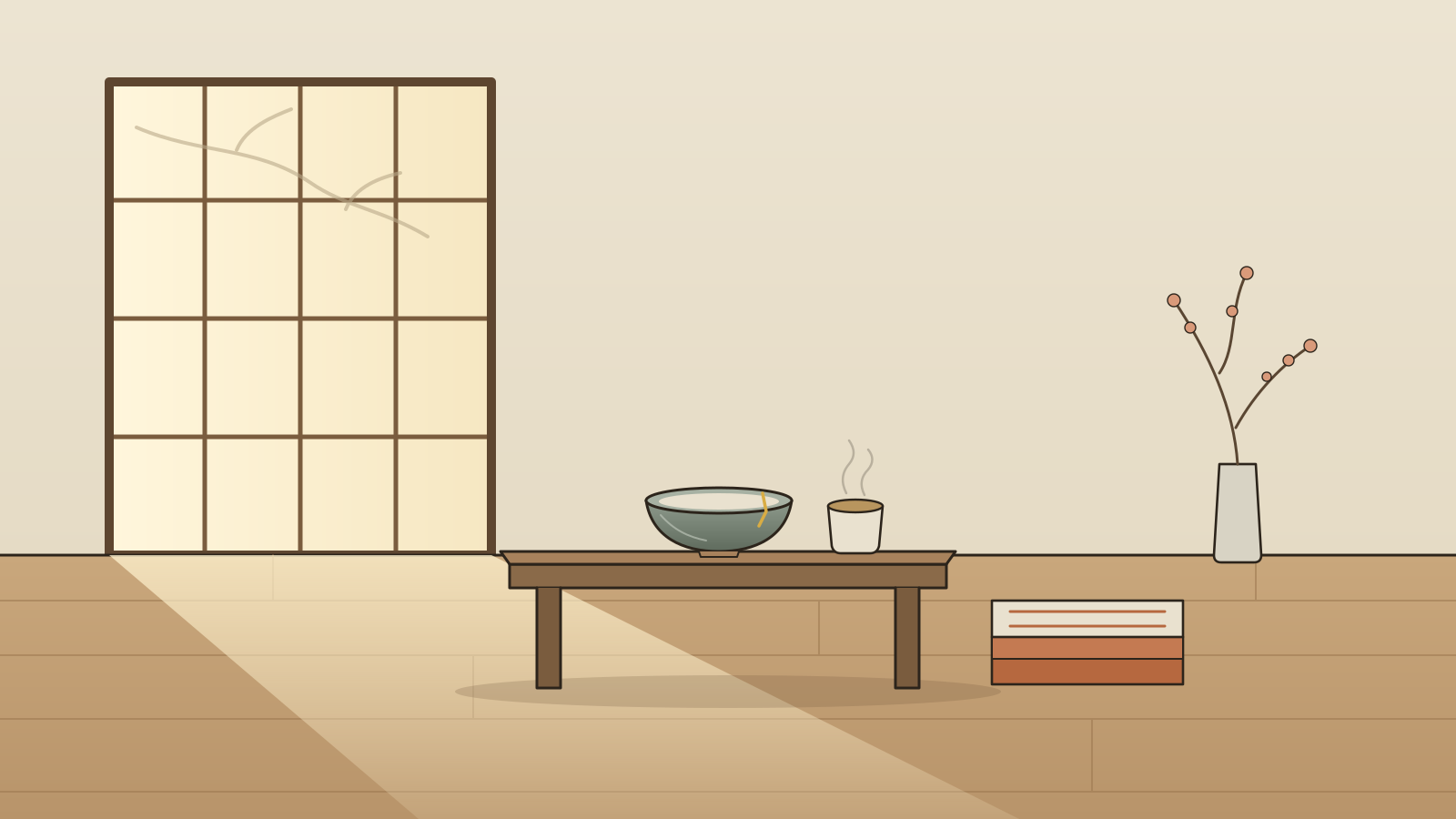
Imagine a room in the early morning.
The floor is bare wood. There’s a low table, and on it a single bowl: handmade, a little uneven, glazed the colour of river stones. Beside it, a cup of tea, still steaming. A folded blanket. A branch in a jar. Light comes in through a paper screen and lies across the floor in soft squares.
That’s almost everything in the room. And yet it doesn’t feel empty. It feels full: of light, of quiet, of space to think. You could sit here for an hour and want for nothing.
Most of us live in the opposite room. Surfaces covered. Drawers that won’t close. Cupboards we’re slightly afraid to open. Things we bought, things we were given, things we’re keeping “just in case”, things we’ve forgotten we own. None of them is a problem on its own. Together, they’re a weight we carry every day without noticing, until we put it down.
This piece is about putting it down.
Three stones on a desk
In 1845, Henry David Thoreau went to live in a small cabin he’d built himself by Walden Pond, in Massachusetts. He kept very little. In the book he wrote about it, he tells a small story that has stayed with readers for over 170 years.
He had three pieces of limestone on his desk. Pretty stones, presumably. But he discovered that they needed dusting every day, while, as he put it, “the furniture of my mind was all undusted still”. So he threw them out of the window.
It’s a joke, and it isn’t. Every object asks something of us: a little attention, a little care, a little space, a little time. One stone asks almost nothing. But a house holds thousands of objects, and their small requests add up to a great deal of a life.
Thoreau had a line for this too: a man is rich, he wrote, “in proportion to the number of things which he can afford to let alone”.
He wasn’t against possessions. He famously kept three chairs: “one for solitude, two for friendship, three for society.” Exactly as many as his life needed, and each one with a purpose.
The people who counted
In the last twenty years, a handful of people have tried an experiment: living with a counted number of things. The numbers themselves are a little arbitrary, and most of them would say so. But what they learned is worth knowing.
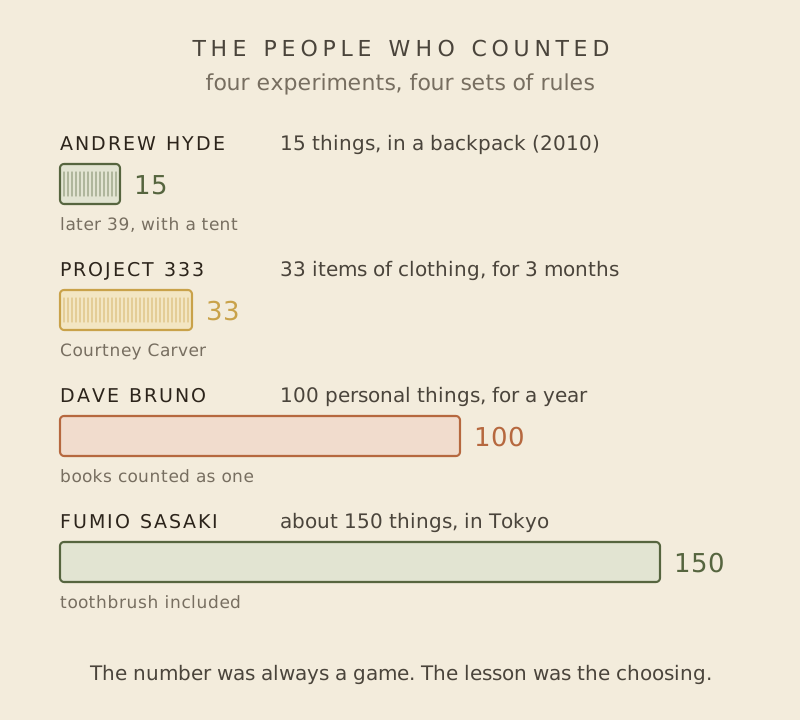
Dave Bruno started it, in a way. He’d been writing online against consumerism, and one weekend, watching his family clear out the house, he saw how much stuff they had. So he set himself a challenge: for a year, he would own no more than 100 personal things. Shared family things, like the table and the dishes, didn’t count. His books counted as one.
The hardest things to let go of weren’t the useful ones. They were the things that belonged to a version of himself he’d never become. He had a box of model trains he’d always meant to build into a layout. He sold them, realising that building it now wouldn’t give him back the time he’d wished he’d spent doing it with his father. He sold most of his woodworking tools too, admitting he liked the idea of being a woodworker more than he wanted to become one.
That’s the first lesson, and the deepest. Many of our things belong to imaginary people: the person who’ll finally take up the guitar, run the marathon, read those books, fit those jeans. Letting go of them isn’t failure. It’s honesty. And it makes room for the person you actually are.
Andrew Hyde, a young American, sold almost everything in 2010 and went travelling with 15 things in a backpack: a couple of shirts, trousers, sandals, a camera, a toothbrush kit, a towel, a pen. People were inspired, or outraged. When he settled down again, his list grew to 39 things, including a suit, a tent and a car. It didn’t mean he’d failed. It meant the number was a tool, not a trophy.
Second lesson: the goal isn’t the smallest number. It’s the right things. A tent is a fine thing to own if you sleep under the stars.
Courtney Carver began Project 333 to break a shopping habit and calm an overflowing wardrobe. The rule is simple: for three months, dress using only 33 items of clothing. Box up the rest. At the end, see what you missed. Many people who try it say their mornings get easier, and that they hardly miss what’s in the box.
Third lesson: we wear a small part of what we own. Choose that part on purpose.
Fumio Sasaki, a book editor in Tokyo, lived in a flat crowded with books, CDs and electronics, and felt his life had stalled. He gave away nearly everything, moved into a flat of about 20 square metres, and now owns roughly 150 things, counting his toothbrush. In his book Goodbye, Things, he offers some of the clearest advice of all:
- Stop keeping things for “someday”. Someday rarely comes.
- Keep only what you could talk about with passion. If you can’t remember why you have it, you don’t need it.
- Borrow instead of owning. A friend who lends you a drill sees you more often. That’s not a cost. That’s a gift.
- If it’s not a “hell yes”, it’s a no. Especially when you’re torn between two nearly identical things.
That last rule, of course, comes from Derek Sivers, whom we met in The Laptop on the Kitchen Table. Sivers sold his company for $22 million and gave the money away. He writes that he has simply lost the urge to buy things. He was writing on a seven-year-old laptop that still worked, and he’d worn the same few clothes for years. His reasons are plain: making things creates waste; money not spent can be invested in freedom; and since he often travels with just a backpack, every possession is a weight that has to earn its place.
The woman who writes about simplicity
Dominique Loreau is a French-language essayist who has lived in Japan since the late 1970s. Her book L’art de la simplicité, published in English as How to Live More with Less, has been translated into many languages. She has written a whole shelf of small books since: on lists, on the essential, on frugality and pleasure, on the infinitely little.
Her writing is gentle, but her ideas are firm. A few of them, in short:
- Beauty is a need, not a luxury. Her simplest rule, and the one she’s most quoted for:
Buy and keep only things you find beautiful.
- Fewer, but better. In her spirit: not one cheap thing replaced ten times, but one well-made thing that lasts, and that you take pleasure in using every day. One good bowl rather than a cupboard of chipped ones.
- We are the vessel, not what we hold. Many people, she observes, come to treat their possessions as proof of who they are. The more they own, the more they feel they exist. But the hunger never ends, and it drains the very energy it promises to give.
- Living with less takes discipline, and it also needs nourishment. You can’t simply empty your life. You have to fill it with better things: reading, walking, conversation, quiet, attention.
- Make lists. In L’art des listes she shows how simple lists, kept by hand in a small notebook, can simplify, organise and enrich a life. Try one of everything you own. Written out by hand, it’s surprisingly sobering, and surprisingly freeing.
- Travel light. The joy of setting off with almost nothing, free of obligations, is something she returns to again and again. Why not live a little more like that every day?
There’s something of the Japanese idea of ma in her writing: the meaningful space between things. In a Japanese room, emptiness isn’t a lack. It’s part of the design. It’s what lets the few things that remain be seen.
The true price of a thing
When we buy something, we think we pay once. We don’t. The price on the tag is only the part we can see.
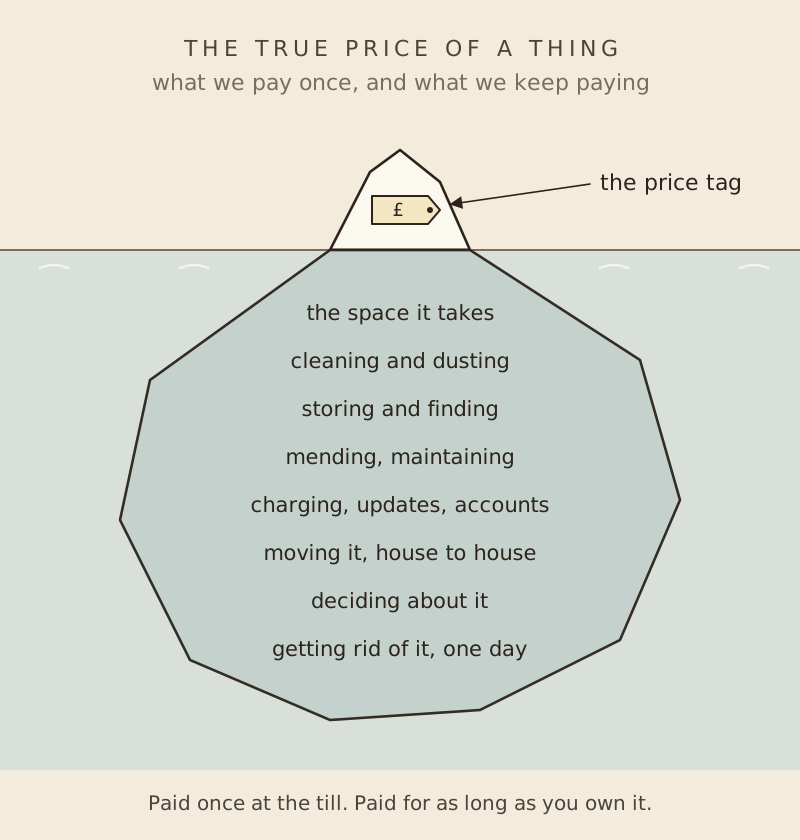
Every object takes space, and space in a home is the most expensive thing most of us pay for. It must be cleaned, stored, found, mended, insured, moved from house to house, thought about. Many modern things ask even more: charging, updating, an account, a subscription, a password. And one day, someone has to decide what to do with it: you, or, as The Gentle Kindness of Death Cleaning reminds us, the people you leave behind.
There’s evidence that the weight is real. In a 2010 study, researchers asked 30 working couples to give a recorded tour of their homes. Women who described their homes using words like cluttered and unfinished had stress-hormone patterns linked to chronic stress, and their mood got worse over the day. Those who described their homes as restful did better on both counts.
And there’s evidence about where happiness comes from instead. In 2003, the psychologists Leaf Van Boven and Thomas Gilovich found that people tend to be made happier by experiences they buy, like a trip, a meal or a concert, than by things. Experiences become part of who we are and the stories we tell. Things fade into the background, and then into the cupboard.
How to choose what stays
So how do you decide? Over a century ago, the designer William Morris gave the best answer in a single sentence, in a lecture called The Beauty of Life, in 1880:
Have nothing in your houses that you do not know to be useful, or believe to be beautiful.
Useful, or beautiful. Ideally both. That’s the first filter. A low-tech life adds a few more.
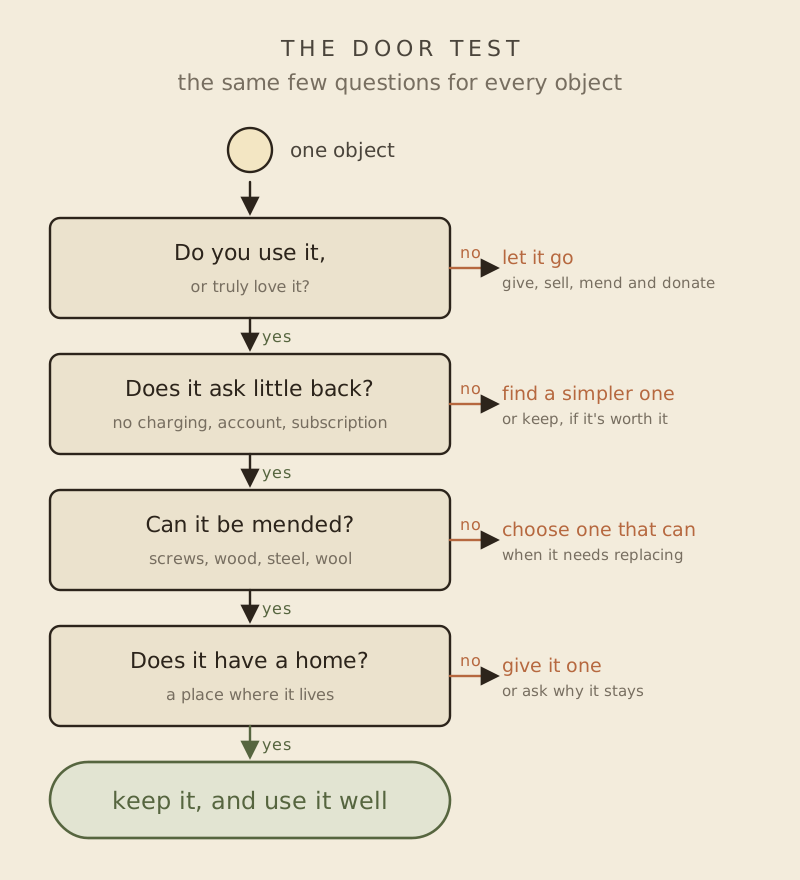
The questions, one by one:
- Do you use it, or truly love it? Not “might use”. Not “quite like”. Used this year, or loved every time you see it. If neither, let it go.
- Does it ask for little in return? Things that need no charging, no account and no updates are quieter companions. A paper notebook, a kettle, a wristwatch that winds, a good pen. When there’s a simpler version that does the job, prefer it.
- Can it be mended? As The Art of Mending showed, a thing you can fix is a thing you truly own. Choose wood, steel, wool, cotton, leather, screws over glue.
- Does it have a home? Everything you keep should have a place where it lives. If it doesn’t, either make one, or ask why you’re keeping it.
- Would you choose it again today? If it broke tomorrow, would you buy it again, at full price? If not, it’s probably staying out of habit.
And two more rules from The Minimalists, Joshua Fields Millburn and Ryan Nicodemus, for the things we keep “just in case”:
- The 20/20 rule. If you could replace it for less than $20 (call it £20), in less than 20 minutes from where you are, you can safely let it go. They say that between them, they’ve needed to replace such an item fewer than five times.
- Borrow it. For the drill you use twice a year, the ladder, the pasta machine, the tent: ask a neighbour, or find a lending library of tools, sometimes called a library of things. Many towns now have one.
A few good things
What does a life of a few good things actually look like? Not a list to copy, just a picture to borrow from:
- In the kitchen: one good knife, kept sharp. A heavy pan that will outlive you. A pot, a board, a wooden spoon. A bowl, a plate, a cup for each person, and a few for guests. Nothing that does only one tiny job.
- In the wardrobe: a small set of clothes that all go together, in colours you love, made to last, worn until they need mending, and then mended.
- For work: one laptop, used for making things, as in The Laptop on the Kitchen Table. A notebook and a pen. A lamp.
- For connection: a phone that stays at the end of the lane, as in the very first piece in this journal. A library card.
- For the body: good shoes for walking. A bag that carries what you need and no more.
- For the soul: a few books you’ll read again. A few objects that carry a story. One good bowl.
The aim isn’t bare walls. It’s a home where everything is there because you chose it, and where there’s room left over for light, for people, and for yourself.
How to begin
Don’t start by emptying the house in a weekend. Start the way every good habit in this journal starts: small, and every day.
- One drawer a day. Take it out, empty it, and put back only what passes the door test.
- A box of maybe. Put the things you can’t decide about in a box. Write today’s date on it. If you haven’t opened it in six months, give it away without opening it.
- One in, one out. Like Dave Bruno: if something new comes in, something old goes.
- A waiting list. When you want to buy something, write it down and wait thirty days. Most of the wants will quietly disappear.
- Write the list. Once a year, in the spirit of Loreau’s lists, write down everything you own, room by room, by hand. You’ll know what to do.
- Let things go well. Give to people who’ll use them, sell what’s valuable, mend and donate, recycle the rest. Letting go doesn’t have to mean throwing away.
- Try Project 333. Box up your wardrobe except for 33 items, for three months. Notice what you miss. Notice what you don’t.
Each step is small. But they add up the way the clutter did, only in reverse. And as Unhooked showed, every thing you don’t buy is money that stays yours, time that stays yours, and a little more freedom.
Back to the room in the early morning.
The bowl is still on the table. You’ve used it every day for years. There’s a small chip on its rim, mended with a thin line of gold. You know its weight, the curve of it in your hands, the sound it makes on the wood. It holds your breakfast, your soup, sometimes a few flowers.
It’s just a bowl. But it’s your bowl, chosen, used, loved and kept. And it’s enough.
That’s the whole secret, really. Not owning nothing. Owning a few good things, and having room, at last, for everything else.
Sources
- Henry David Thoreau, Walden (1854), chapters “Economy”, “Where I Lived, and What I Lived For” and “Visitors”
- Dave Bruno, The 100 Thing Challenge (2010); review at Shay Shortt
- Scott Berkun, Interview: the man who owns 15 things (2010), and Grist, The guy with 15 things got some more things
- Courtney Carver, Project 333
- Fumio Sasaki, Goodbye, Things (2017); his advice at Remodelista
- Derek Sivers, Own nothing
- Dominique Loreau, L’art de la simplicité (English edition: How to Live More with Less); author page and books, quotes, and an excerpt on possessions
- The Minimalists, Getting rid of just-in-case items: 20 dollars, 20 minutes
- Darby Saxbe and Rena Repetti, No Place Like Home: Home Tours Correlate With Daily Patterns of Mood and Cortisol, Personality and Social Psychology Bulletin (2010), listing
- Leaf Van Boven and Thomas Gilovich, To Do or to Have? That Is the Question, Journal of Personality and Social Psychology (2003)
- William Morris, The Beauty of Life (1880); Wikiquote