A Business of One · Brick 1
Good Work 17 min read
The Laptop on the Kitchen Table
A new machine, a very small business, and a quiet road to freedom — what you can build with almost no money, one evening at a time
Listen · 17 min
Download for later
Today you get a new laptop.
It comes in a box that’s nicer than it needs to be. You lift the lid, peel off the thin film, and there it is: a slab of metal and glass, perfectly clean, smelling faintly of factory. You set it on the kitchen table, in the spot where the morning light falls, and you switch it on.
For a moment, before you sign into anything, it’s completely empty. No feeds. No notifications. No red dots. Just a blank screen and a blinking cursor, waiting to find out what kind of machine it’s going to be.
Because that’s the thing about a laptop. It’s not one machine. It’s whatever you make of it.
It can be a television that never ends. It can be a slot machine for your attention, the most expensive way ever invented to lose an evening.
Or it can be something else entirely. Fold it open and it’s a workshop. A printing press. A shop front that never closes. A post office that reaches every country on earth. A classroom. A ledger. A drawing board. A recording studio. Things that once needed a building, a staff and a bank loan now fit inside something the size of a chopping board, on a kitchen table, between the fruit bowl and the salt.
So before you install anything, you take a small sticky note, write five words on it, and press it onto the edge of the screen:
This machine is for making.
This piece is about what happens next.
What the laptop really is
For almost all of history, starting a business meant putting money at risk before you’d earned a penny. A shop needed rent, stock, a sign, a counter. A workshop needed tools and premises. A publisher needed a press. You borrowed, you gambled, and if it didn’t work, you owed.
That’s still true for many businesses. But for a whole family of them, it has quietly stopped being true. If the thing you sell is knowledge, skill, writing, software, design or help, then nearly all of your “factory” is already sitting on your kitchen table.
Think about what it costs to start, at the smallest possible scale:
- The laptop. You have it.
- A name on the internet. A domain costs roughly the price of a takeaway for a whole year.
- A simple website. A single page is enough. It can be hosted for very little, often for nothing.
- A way to be paid. Payment services take a small fee from each sale, and nothing upfront.
- A notebook and a pencil. Still the best planning software ever made.
That’s it. No stock. No office. No staff. No loan.
And this is where the low-tech life and the business life turn out to be the same idea. In Unhooked, we talked about debts as chains. A business that starts without debt starts free. If it fails, you’ve lost some evenings, and gained a great deal of knowledge. If it works, every penny it earns is yours to keep, or to use to buy back your time.
The trap and the path
Before the ideas, a warning, because there’s a trap at the start of this road, and nearly everyone walks into it.
The trap is building the big thing first. You have an idea for an app, a platform, a marketplace. You spend a year of evenings building it, polishing it, adding features, choosing fonts. You launch, and nobody comes. Not because the idea was bad, but because you built it alone, in the dark, for people you’d never actually spoken to.
The path is the opposite, and it’s the same lesson as Do One Thing Well: John Gall’s law. Every complex system that works grew out of a simple system that worked. You don’t build a business. You grow one, from something so small it almost seems silly.
Sahil Lavingia, who built the online shop platform Gumroad, wrote a book about exactly this, called The Minimalist Entrepreneur. His advice reads like a page from this journal:
- Start with a community. Find a group of people you already belong to or care about, and learn what they struggle with before you build anything.
- Build as little as possible. Do it by hand first. Pen and paper, email, a spreadsheet. Only automate what you’ve proven people want.
- Sell to your first hundred customers. One by one: people you know, then your community, then strangers. Charge from the start.
- Stay profitable. Don’t spend money the business hasn’t earned.
Paul Jarvis, a designer who spent years working alone, wrote a companion book called Company of One. His question is even more radical: what if your business didn’t need to grow at all? What if, instead of more, you aimed for enough: enough income for a good life, with time left over for the people and things you love? Start on the side, he says. Keep your job until the small thing can stand on its own. Keep your costs low. Grow only as fast as your customers ask you to.
Seven small doors
So what might you actually make? Here are seven ways in. None needs more than a laptop, some evenings, and a willingness to talk to people.
1. Sell what you already know
The fastest first pound comes from a skill you already have. If you can write, design, build websites, fix spreadsheets, translate, edit video, keep accounts or teach a language, there are people and small businesses who need it done this month.
This is freelancing, and it’s the oldest door of all. Its weakness is that you’re trading hours for money, so it can’t make you free on its own. But it’s a superb first step. It teaches you to find customers, to talk about money, and to deliver. And it pays while you learn.
This week: write down three things you’re better at than most people around you. Tell five people you know that you’re taking on a small piece of work in one of them.
2. Sell a result, not your hours
The second door is a small but powerful twist on the first. Instead of selling time, you sell a fixed result for a fixed price. “A website speed check and a written report, delivered in five days, for £350.” “Your bookkeeping tidied and ready for the tax return, £200.” “A one-page website for a local trade, built in a week.”
This is sometimes called a productised service. The customer knows exactly what they’ll get and what it costs. You get to refine the same job until you’re very good and very fast at it. And because it’s the same job each time, you can write a checklist, then a template, then perhaps a tool. Which leads to the next door.
This week: pick the one job you’ve done most often. Write it as a single sentence with a scope, a time and a price.
3. Make one small, sharp tool
In 2006, Patrick McKenzie was working as a salaryman for a large company in Japan. In his spare time he wrote a small program that did one thing: it made bingo cards. Teachers use bingo in the classroom to practise spelling and vocabulary, and making the cards by hand is tedious. His program did it in seconds.
That’s all it did. In its first year, Bingo Card Creator sold a little under $6,500, against costs of around $2,500. It was a modest start, but it was real money from strangers for something he’d built alone. He kept improving it, and learning how people found it, year after year. By April 2010 the business, with some consulting on the side, let him leave his job and work for himself.
His customers weren’t only teachers. Parents used it to teach their children to read. Care homes used it for activities. Companies used it as an icebreaker. A small, sharp tool, made well, finds people you’d never have guessed.
This week: notice a fiddly task that a particular group of people repeats every week. Could a small program, a template or a spreadsheet do it for them?
4. Gather a useful list
In 2014, a Dutch developer named Pieter Levels was travelling and working from different cities. He made himself a simple spreadsheet comparing cities by internet speed, cost of living and safety, the things a remote worker cares about. Other people wanted it. He turned the spreadsheet into a website called Nomad List.
Over the following decade he launched more than seventy products, and by his own account most of them failed. But the few that worked grew large: by 2020 his small collection of sites was earning more than a million dollars a year. He still works without employees, using automation instead of hiring.
The lesson isn’t the money. It’s where it began: one person, one spreadsheet, solving his own problem, and sharing it. Many good businesses are a well-kept list: the best places, the right suppliers, the trustworthy tradespeople, the jobs, the grants, the events.
This week: what list do you keep for yourself that others would find useful? Share it, for free, with the people who’d care.
5. Teach what you’ve just learned
You don’t need to be the world’s expert to teach. You only need to be a few steps ahead of someone, and remember what it was like to stand where they are. Often, the person who has just learned something explains it best.
This door can be a newsletter, a short guide, a course, a set of video lessons or a small book. In 2008 the writer Kevin Kelly published a short essay called 1,000 True Fans. His argument: a creator doesn’t need millions of followers. If you have a thousand people who truly value your work, and each spends around $100 a year on it, that’s $100,000: a living, not a fortune. If they spend less, you need more of them. If you sell to them directly, you keep more of each sale and need fewer.
This week: write down something you’ve learned in the last year that took you far too long to figure out. Explain it clearly, in one page, and share it.
6. Be your neighbourhood’s digital helper
Not every laptop business lives on the internet. Down your street there are hairdressers, plumbers and cafés with no website, or one that hasn’t worked since 2015. There are older neighbours who’d love to video-call their grandchildren but can’t make it work. There are small charities drowning in spreadsheets.
This is the Repair Café idea from The Art of Mending, applied to technology: patient, local help from someone who understands the machines. It needs no audience, no marketing budget and no app. It needs a printed card in the local shop window and a reputation for being kind and reliable. And it often grows by word of mouth alone.
This week: ask three small local businesses what part of the computer side of things drives them mad.
7. Sell your own craft, directly
If you make things that can travel through a wire, like photographs, illustrations, music, writing, patterns or plans, you can sell them yourself, without a gatekeeper.
In 1998, a musician named Derek Sivers couldn’t get his album into the shops. So he set up a simple way to sell it online, and soon other independent musicians wanted the same. That small service became CD Baby, which grew to sell music for well over a hundred thousand musicians. Ten years later he sold it for $22 million, and gave the money to a charitable trust for music education. In his little book Anything You Want, he says business plans are mostly moot, because you don’t know what people want until you start. And he offers a rule for choosing what to do: if your answer isn’t “hell yeah”, it’s no.
This week: put one thing you’ve made where people can buy it. Just one.
The staircase
These doors aren’t separate paths. They’re steps on one staircase, and you can climb it slowly.
Rob Walling, who has spent many years helping people start small software companies, calls it the stair-step approach. Start with something simple that’s sold once, using one way of reaching people. Do it again, until together they earn enough to “own your time”. Only then take on the harder thing: a product people pay for every month.
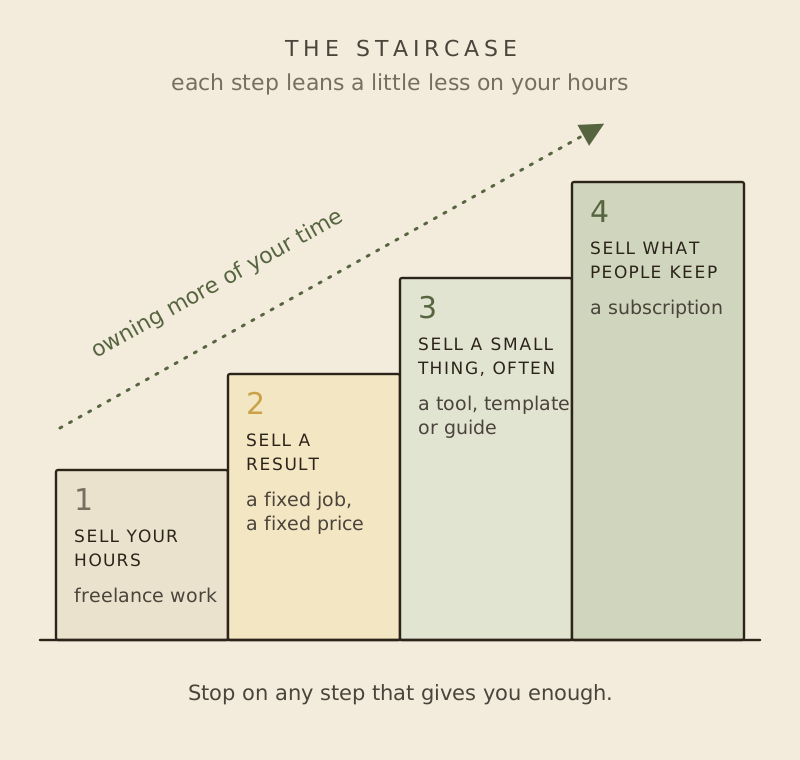
Notice that each step leans less on your hours. On the first, you’re paid only while you’re working. On the last, you’re paid for something you built once and keep caring for. That’s the shape of freedom: income that no longer depends on every hour of your day.
How much is enough?
Here’s the most important number in this whole piece, and it isn’t a sales figure. It’s your enough: the monthly income that would cover a calm, simple life. In Unhooked, we worked out how to find it. Now look at what it does to a business.
Say your enough is £2,000 a month. That sounds like a lot to earn on your own. But look at the different ways to reach it:
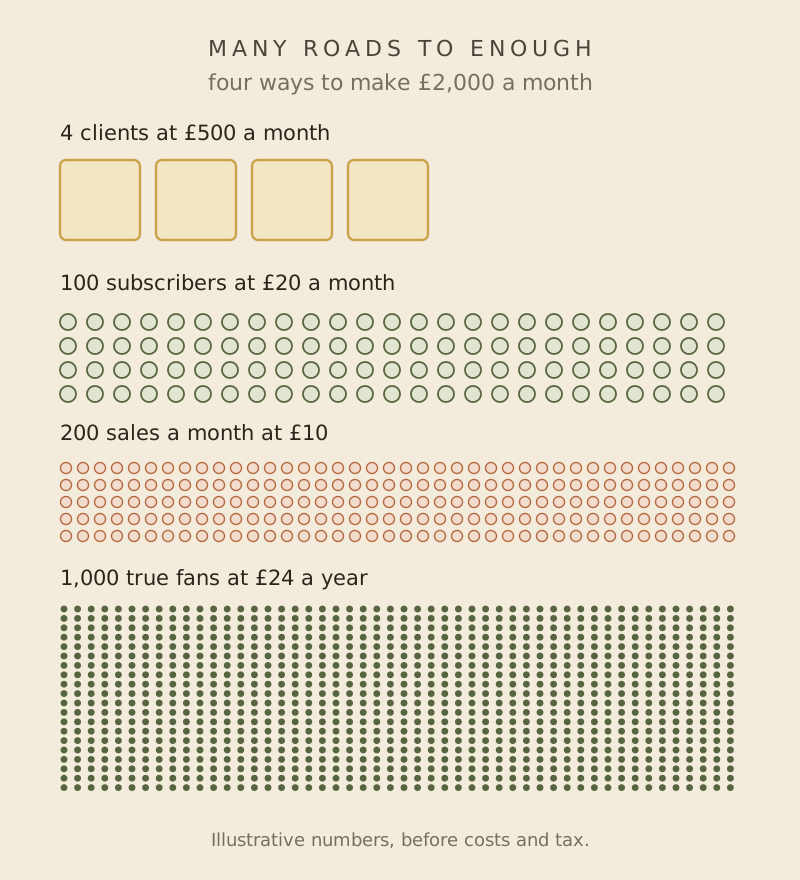
Four clients. A hundred subscribers. A thousand people who value what you do. None of these is a unicorn startup. All of them are within reach of one person with a laptop and some patience.
And now the low-tech life plays its strongest card. Every pound you don’t need each month is a pound your business doesn’t have to earn. Lower your enough from £2,000 to £1,500, and you need three clients instead of four, seventy-five subscribers instead of a hundred.
It works the other way, too. Savings buy you time to build: they’re your runway, the months you could live while the business finds its feet. Halve your spending, and your runway doubles.
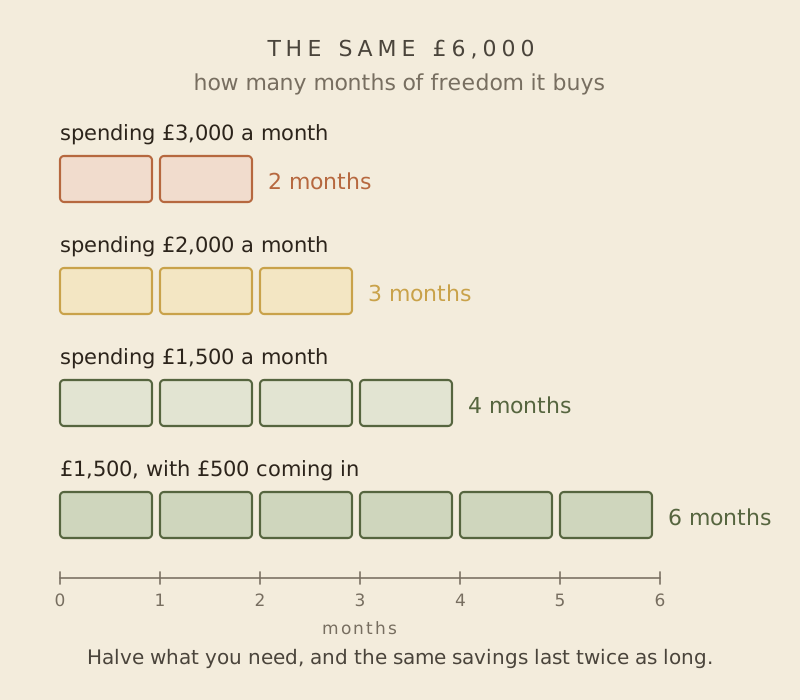
This is the quiet secret that ties the whole journal together. Minimalism isn’t only about having fewer things. It’s a way of needing less, and needing less is what makes freedom affordable. The person who can live well on a little doesn’t need a big business. They need a small, good one.
A year at the kitchen table
So let’s go back to the kitchen table and the new laptop with the note on its edge. Here’s how a year might go. Not a promise, just a shape.
The first month is for listening. You don’t build anything. You talk to people in a community you belong to: other parents, other developers, local shop owners, fellow gardeners. You ask what’s hard, what they’ve tried, what they’d pay to make go away. You write every answer in the notebook.
The second month, someone asks if you could help. You say yes, and you name a price, and it feels terrifying. They say yes too. That first payment, maybe £150 for a job done on two evenings, is the most important money you’ll ever earn. Not for its size. For what it proves.
By the fourth month, you’ve done the same kind of job four or five times. You notice the pattern, and you turn it into an offer with a fixed scope and price. You write it on a single web page. People start to find it.
By the sixth month, you’ve written a checklist so good that you start to wonder if you could sell the checklist itself. You make it into a small guide, or a template, or a little tool. It sells a few copies a week, sometimes while you sleep.
By the ninth month, there are two or three small streams of money. None is large. Together, they pay for the weekly shop.
By the twelfth month, the laptop has a scratch on its lid and crumbs in its keyboard. The sticky note has faded but you’ve never taken it off. The business earns a few hundred pounds a month. That’s not freedom yet. But it’s runway, growing every month. And something has changed that’s worth more than the money: you know, now, that you can do it. You’ve found customers, been paid by strangers, made things people value. The road ahead is long, but you’re on it.
The ground rules
A few simple rules to keep the road safe and the business small and good:
- Never borrow to start. If it needs a loan before it’s earned a pound, it’s the wrong first business.
- Keep your job, at first. Build on the side. A salary is a gift of time to get it right.
- Check your employment contract. Some contracts limit outside work, or claim ownership of things you make. Know where you stand before you begin.
- Charge from the start. Free work teaches you little about what people value.
- Use one channel at a time. One place where your people already gather, done well, beats five done badly.
- Keep the tools few. The same lesson as The Fewest Doors: each extra service is a cost, a login and something else to break. A notebook, an email address, a simple page and a way to be paid will carry you a long way.
- Guard your evenings. Your family, your sleep and your health are not raw materials for the business. As Four Thousand Weeks reminds us, your time is the very thing you’re trying to win back. Don’t spend all of it to get there.
- Decide your enough, and write it down. Without a number, “more” never ends.
And in the UK, a few practical notes. You can earn up to £1,000 a year in gross income from a small side business without telling HMRC, using what’s called the trading allowance. Above that, you’ll usually need to register for Self Assessment, normally by 5 October after the end of the tax year in which you started. Starting as a sole trader is the simplest way in. Under the new Making Tax Digital rules, sole traders with qualifying income over £50,000 must keep digital records and send quarterly updates from April 2026, with the threshold dropping to £30,000 in 2027 and £20,000 in 2028. None of this needs to frighten you: keep a simple record of every pound in and out from day one, and ask an accountant when you grow. (I’m not a tax adviser or an accountant, so check GOV.UK for the current rules.)
What the freedom is for
In The Last Evening, we asked what a life well lived looks like from the end. Nobody, on that last evening, wishes they’d built a bigger company. What people wish for is time: with the people they love, doing work that felt like theirs, outdoors, unhurried, free.
That’s what this is really about. Not getting rich. Getting free. Free to walk your child to school. Free to take a slow afternoon off in the middle of the week. Free to say no to work that doesn’t feel right. Free to choose.
The laptop can’t give you that on its own. But it’s the most powerful tool for independence that an ordinary person has ever been able to buy. Most people will use theirs to watch other people’s lives.
You can use yours to build one.
It’s late now. The house is asleep. The kitchen light is on, the tea has gone cold, and the laptop’s screen glows on the table. In the notebook beside it, there’s a list of names: the five people you’re going to write to tomorrow.
You don’t feel ready. You won’t, not yet. As Cold Start puts it, the fire comes after the first step, not before.
The note on the edge of the screen still says what it said this morning.
This machine is for making.
Begin small. Begin tonight.
Sources
- Sahil Lavingia, The Minimalist Entrepreneur (2021); summary and notes at A Generalist
- Paul Jarvis, Company of One (2019); summary at Blinkist
- Patrick McKenzie, Happy birthday, Bingo Card Creator (2007) and Bingo Card Creator year in review 2010
- Indie Hackers, From Google Sheets to $3.6M as a solo founder, on Pieter Levels and Nomad List
- Kevin Kelly, 1,000 True Fans (2008, revised)
- Derek Sivers, Anything You Want; on CD Baby’s sale, Built to Sell
- Rob Walling, The stair step approach to launching products, Startups for the Rest of Us
- Bytestart, The £1,000 trading allowance
- GOV.UK, Find out if and when you need to use Making Tax Digital for Income Tax