Essentialism 16 min read
The Two-Pound Bag
On being ready for whatever comes — what Shackleton's men kept on the ice, why a light life starts faster, and the short list of things that truly matter
Listen · 16 min
Download for later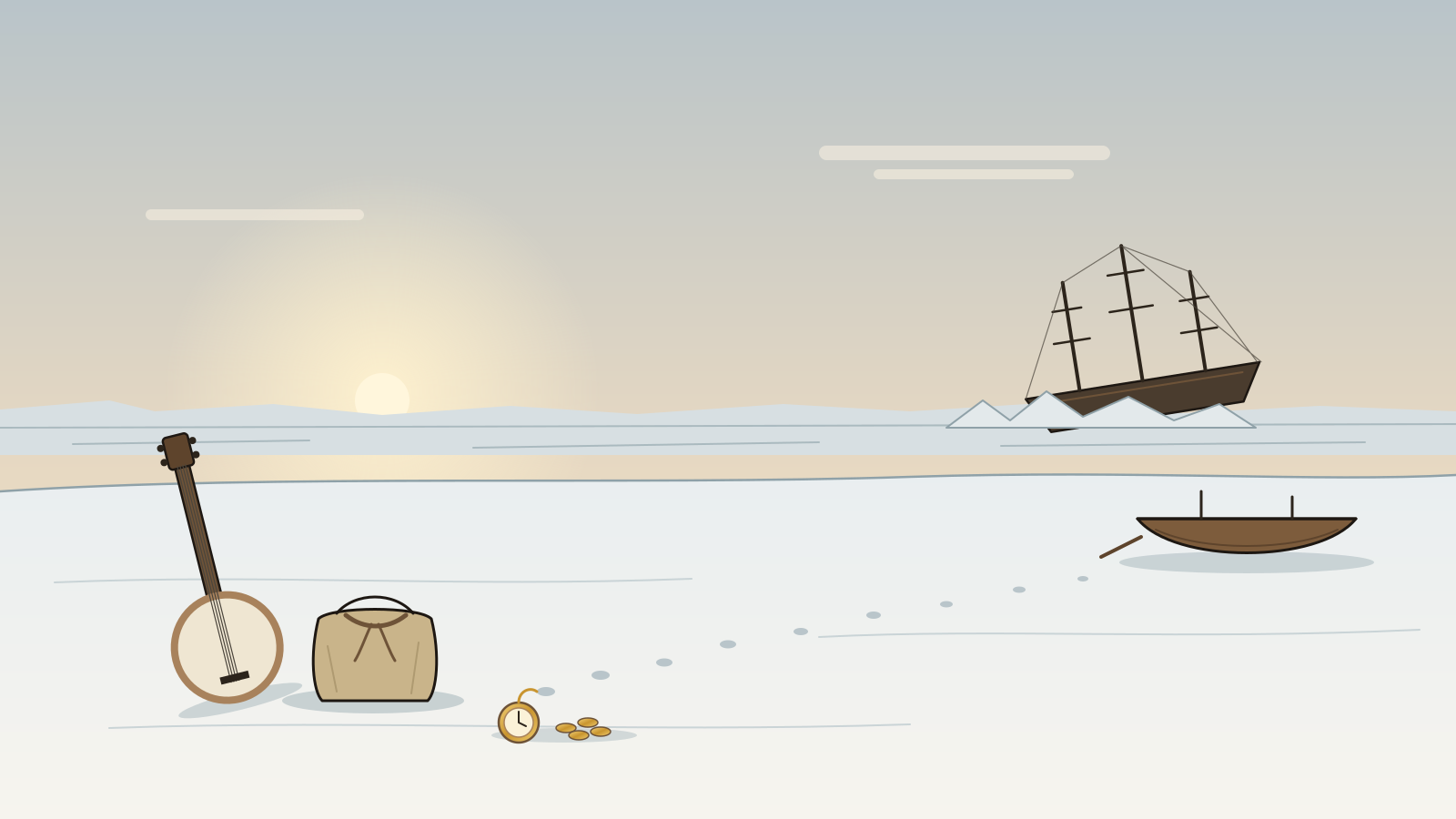
On the evening of 27 October 1915, on the frozen Weddell Sea, the ice finally broke the back of the Endurance. For ten months the ship had been trapped, drifting with the pack. Now the pressure was crushing her timbers, and Ernest Shackleton gave the order to abandon ship.
Twenty-eight men stood on the ice, more than a thousand miles from anyone, with winter’s end still months away and no radio that could reach the outside world.
Shackleton knew that what they could carry would decide whether they lived. Every ounce would have to be dragged across broken ice, and later rowed across the most violent seas on Earth. So beyond their clothes, a sleeping bag, mittens and socks, each man could keep two pounds of his own things. About as much as a bag of sugar.
Then, in front of them all, Shackleton did something they never forgot. He took a handful of gold sovereigns from his pocket, and his gold watch, and dropped them in the snow. He laid down the Bible that Queen Alexandra had given the expedition, and tore out only three pages to keep: the flyleaf with her written prayer for their safety, the 23rd Psalm, and a page from the Book of Job.
The men followed. Out went books, instruments, keepsakes, clothes. What stayed tells you a great deal about people: photographs of wives and children, diaries, toothbrushes, small objects of faith, the surgeons’ medical kits.
And one more thing. Leonard Hussey’s banjo weighed twelve pounds, six times the allowance. Shackleton insisted it came, lashed under a lifeboat. He called it vital medicine for the mind. Through the months of waiting that followed, it played on the ice, and the men sang.
They camped on the floe for months. They took to the lifeboats. They reached Elephant Island. Shackleton and five others sailed an open boat eight hundred miles to South Georgia, then crossed its unmapped mountains on foot to a whaling station. In August 1916 he came back for the rest.
All twenty-eight men survived.
In March 2022, searchers found the Endurance three kilometres down, upright and astonishingly whole, the brass letters of her name still shining on the stern. Everything the men had left behind was down there with her. Everything that mattered had walked away across the ice.
Ready for what?
We don’t know what’s coming. Nobody does. Illness, a job lost, a power cut, a flood, a crash in the markets, the death of someone we love, a phone call at three in the morning. Most of us will meet several of these in a lifetime. Some we’ll see coming. Most we won’t.
The usual answer to that uncertainty is more: more insurance, more stuff in the garage, more money, more gadgets, more plans. And some of that has its place. But Shackleton’s two-pound bag points somewhere else. When the ice breaks, the person who is readiest isn’t the one with the most. It’s the one who already knows what matters, has looked after those few things well, and is carrying very little else.
That’s why everything this journal has been about turns out, quietly, to be preparation.
- A person who lives with fewer things, as in One Good Bowl, has less to lose, less to move and less to protect.
- A person who has taken off the small chains of Unhooked (the debts, the subscriptions, the overfull calendar) has room to absorb a shock without breaking.
- A person who can mend, as in The Art of Mending, doesn’t panic when something breaks.
- A person who can walk, carry and get up off the floor, as in A Ladder of Small Movements, can look after himself and others.
Minimalism and essentialism aren’t just about calm rooms. They’re a head start. A light life is a ready life, because when the day comes there’s simply less to throw onto the snow.
How engineers prepare for disaster
There’s a lesson here from the people who build large computer systems, and it’s surprisingly human.
Engineers talk about a single point of failure: one part that, if it breaks, takes everything down with it. One power supply. One disk. One database with no copy. Good systems are designed so that no single break is fatal. They have redundancy: a second disk, a backup, another route. And they degrade gracefully: when part of them fails, they keep doing the most important things and quietly drop the rest, just like the Apollo computer in The Computer That Knew What to Drop.
In 2011, Netflix went further. Its engineers built a tool called Chaos Monkey, which wandered through their live systems and switched off servers at random, on ordinary working days. It sounds mad. But the reasoning was sound: servers were going to fail anyway, at the worst possible moment. Better to make failure ordinary, practised and boring, so that when it came for real, nobody noticed.
Two thousand years earlier, Seneca was giving his friend Lucilius the very same advice:
Set aside a certain number of days, during which you shall be content with the scantiest and cheapest fare, with coarse and rough dress, saying to yourself the while: “Is this the condition that I feared?”
And then the reason, which every soldier understands: in days of peace the soldier performs manoeuvres, throws up earthworks with no enemy in sight, and wearies himself by gratuitous toil, in order that he may be equal to unavoidable toil.
That’s what this piece is about. Not fear, not a bunker, not stockpiles. Small, calm practice in peaceful times, so that hard times find you steady. A life with no single point of failure, that degrades gracefully, and that has rehearsed.
What truly matters
So what goes in your two-pound bag?
If you strip a life back the way the ice stripped those men, the same few things appear, again and again, in every culture and every century. Here they are, roughly in the order you’d need them.
1. Your body
It’s the one house you can never move out of. When things go wrong, it carries you, and very often it has to carry other people too.
You don’t need to be an athlete. You need to be able to walk a long way, carry something heavy, get down to the floor and back up, sleep, and recover. Those are exactly the rungs of A Ladder of Small Movements. Add the plain food of The Plate That Gives Energy Back, and a body that’s used to being a little cold, a little hungry, a little tired now and then, without complaint.
A strong, ordinary body is the first item in the bag, and it weighs nothing.
2. Your people
The Harvard Study of Adult Development began following a group of young men in 1938, and has followed some of them, and later their families, ever since: one of the longest studies of human life ever made. Its director, Robert Waldinger, sums up eighty years of data in a single plain sentence: good relationships keep us happier and healthier. In one of its striking findings, the men who were most satisfied in their relationships at fifty were the healthiest at eighty. Not the richest. Not the most successful. The most connected.
Look again at the ice. What did the men keep? Photographs of the people they loved. What kept them sane? A banjo and twenty-eight voices singing together. Shackleton’s real genius wasn’t navigation. It was keeping a group of frightened men together.
So, practically:
- Know who you’d call at three in the morning. Then ask whether they know they could call you.
- Keep that small list of numbers on paper too, in your wallet and in the kitchen drawer. Phones die, and few of us remember anyone’s number now.
- Be the neighbour people know. In a long power cut or a flood, the street matters more than the internet.
- Mend what needs mending between people now, while there’s time. That was the heart of The Last Evening.
3. A steady mind
When the ice breaks, there’s a short moment where you either panic or start thinking. The Stoics practised for that moment every day.
The first tool is the oldest: sort everything into up to me and not up to me, as Epictetus taught and as we explored in Be Like the Headland. The ice was not up to Shackleton. What he did next was.
The second tool is what Seneca and the later Stoics practised as premeditation of evils: every so often, calmly imagine losing something. Your job. Your health for a season. The house. Not to frighten yourself, but to see clearly what you’d do, and to notice how much would still remain. It’s the Chaos Monkey of the mind. A fear you have rehearsed is half its size.
The third is routine. On the ice, Shackleton kept regular meals, watches, chores and small celebrations, because routine gives a frightened mind something solid to hold. In any crisis, at home too, the first thing to rebuild is the shape of a day: get up, wash, eat, move, do one useful thing, sleep.
4. Hands that know things
Skills are the only possessions that get lighter the more you own. Nobody can take them from you, and they never need dusting.
A short list worth having, slowly, over the years:
- Cook a few good meals from plain ingredients, with no recipe and no app.
- Mend: sew a button, fix a puncture, unblock a drain, change a fuse, tighten a hinge.
- First aid: a one-day course, and a refresher every few years. It’s the skill most likely, by far, to let you help someone you love.
- Find your way without a phone: read a paper map, know the roads, know where your nearest hospital is.
- Swim. Not well. Just enough.
- Make a fire, safely, and keep warm without the heating on.
- Your trade, whatever it is, done well enough that someone would still pay for it in hard times.
5. A cushion
Money isn’t the most important thing. But having none in reserve turns every small problem into a crisis, and every crisis into debt.
The Financial Conduct Authority’s 2024 survey found that one in ten UK adults had no cash savings at all, and one in four had low financial resilience, meaning a modest shock could knock them over.
A cushion doesn’t have to be big to change everything:
- First, a few hundred pounds, kept somewhere boring and easy to reach. That covers the broken boiler or the car repair that would otherwise go on a card.
- Then, one month of essential spending.
- Then, slowly, three to six months.
That cushion buys the one thing a crisis always tries to take away: time to think. And it grows far faster in a life that has already shed its subscriptions and spending chains. Keep a little cash at home too, in notes and coins. When the card machines are down, cash still works.
As in Unhooked: this is general information, not financial advice. If debt is weighing on you, the UK’s free debt advice services are the right first call.
6. Papers, keys and wishes
When something happens to a person, those left behind almost always face the same frightened question: where is everything?
The Money and Pensions Service found that over half of UK adults, 56%, don’t have a will. Without one, the people you love can be left with delay, cost, and decisions made by strangers. In England and Wales you can also set up a lasting power of attorney, so someone you trust can act for you if you’re ill and can’t.
Then make a readiness folder. One folder, one place, and two people who know where it is:
- your will, and any power of attorney;
- copies of passports, driving licence, birth and marriage certificates;
- a list of accounts, pensions and insurance policies (names and numbers, not passwords);
- how to get into the digital life you set up in The Keyring and the Drawer;
- the paper list of important phone numbers, and anyone’s medication and doses;
- a short letter to the people you love. What you want them to know. Where to start.
This is death cleaning‘s gentle kindness, done early. It takes an afternoon. It saves the people you love weeks of searching on the worst days of their lives.
7. A reason
Shackleton tore three pages from a Bible. Other men kept a photograph, a cross, a diary. Whatever you believe, look at what they carried across the ice: not what they had, but who they loved and what they believed.
Viktor Frankl, who survived the Nazi camps, wrote that even when everything else is taken, a person keeps one freedom: to choose their attitude to what is happening. He noticed that the people who held on were very often those with a reason to: someone waiting for them, work still to finish, a purpose beyond themselves.
You don’t need to have it all worked out. But it’s worth knowing, in one or two sentences, what you’re for. Write it down. Put it in the folder. It’s the page you’d tear out of the book.
The three-day box
Now, the practical part. The ice, for most of us, will be smaller and stranger: a storm that takes the power out for days, a burst water main, a cyber-attack that stops the shops’ card machines, a flood that closes the roads.
In October 2026, the UK government began a three-year campaign called Be Ready, asking every household to be able to manage for at least three days without electricity, water, phones or the internet. Its checklist is sensible, short, and almost entirely low-tech:
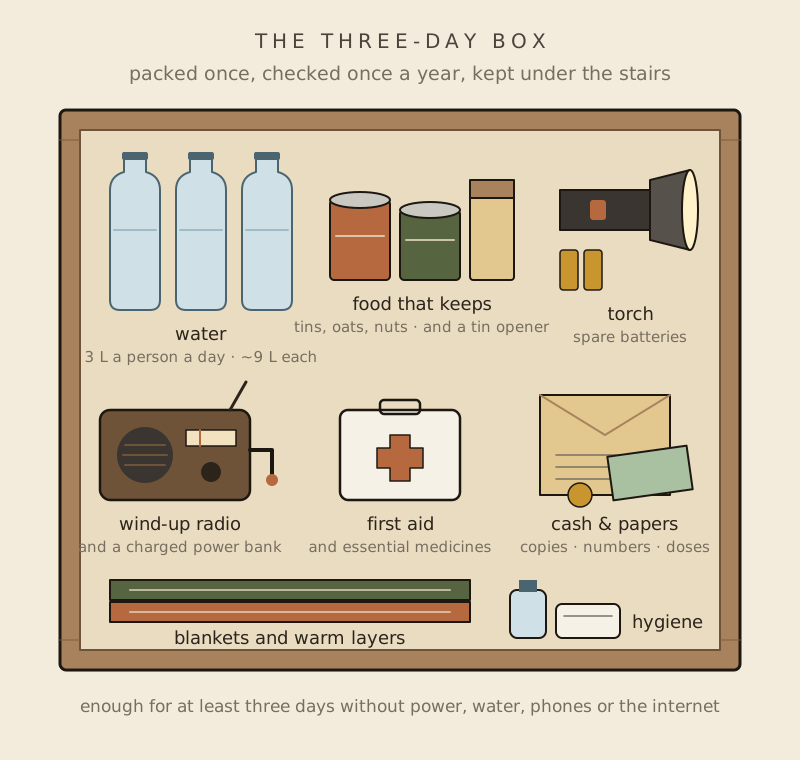
- Water: three litres per person per day, so about nine litres each, plus extra for cooking and washing, and some for pets.
- Food: three days of things that keep and need little or no cooking (tinned fish and beans, dried fruit, nuts, oats). And a tin opener.
- Light and warmth: a torch, spare batteries, blankets, warm layers.
- News: a wind-up or battery FM radio, and a charged power bank.
- Money and papers: cash in notes and coins, copies of important documents, a paper list of phone numbers and medication doses.
- Health: a first aid kit and essential medicines, with repeat prescriptions ordered well before they run out.
- Hygiene: hand sanitiser, wipes, the basics. Plus nappies and formula for babies, if you have them.
Notice something. That box is almost a definition of low-tech living. It’s the life of The Phone at the End of the Lane, packed into a crate. A household that already cooks plain food from tins and jars, keeps a radio, uses cash sometimes, and isn’t lost when the phone dies is three-quarters of the way there already.
Don’t panic-buy it all in one go. Add a little to the weekly shop. Use the older tins and replace them, so nothing goes to waste.
Training, not worrying
Here’s the heart of it. Being ready isn’t a purchase. It’s a practice, like everything else in this journal. Seneca’s practice days and Netflix’s monkey are the same idea: rehearse in peace, so the real thing feels familiar.
A gentle rhythm for a household:
- Every week: move your body properly a few times. Speak to a friend you’d want beside you in a crisis, not just message them.
- Once a month, a Seneca day: plain food, no car if you can manage it, a long walk in whatever weather there is, an evening without screens. Ask yourself, as he did: is this the condition that I feared? Usually the answer is: no, actually, this is rather good.
- Once a season, lights out: flip off the power at the fuse box for an evening (keep the fridge and freezer closed). Cook on what you have, play cards by torchlight, listen to the radio. Children love it, and they learn, without a single word of worry, that the dark is fine and the family knows what to do.
- Once a year, check the system: the box, the folder, the will, the numbers on paper, the cushion. Replace old water and tins. Tell the people who need to know where everything is.
Engineers have a saying: a backup you have never restored isn’t a backup. It’s a hope. The same is true here. A plan nobody has practised is just a wish.
For those of us who think in terminals, the yearly check might look like this:
# once a year: check the system
check body      # walk 5 km, carry the shopping, up off the floor
check people    # three numbers on paper; they know they can call me
check mind      # up to me / not up to me; a day still has a shape
check hands     # first aid still fresh; one new skill this year
check cushion   # one month, then three, then six
check papers    # will, attorney, folder; two people know where
check box       # nine litres each, three days of food, torch, radio
check reason    # one or two sentences; still true?
Your two-pound bag
Here’s an exercise for a quiet evening, with a pencil and a single sheet of paper.
Imagine you have to leave tonight. Not forever, but for a long time, and with only what you can carry in a small bag. Write down what goes in it.
Then turn the paper over and write down what you’d leave on the ice.
Most people find the second list is much longer, and that it’s full of things they spend most of their time, money and worry on. Status. Possessions. Being right. Old grudges. The gold sovereigns we all carry in our pockets without noticing the weight.
The first list is usually short, and nearly always the same: the people we love; our health; a few skills; something to believe in; enough to get by. The two-pound bag.
That’s what truly matters. Not because a disaster is coming. It may never come. But because those are the things worth building a life around anyway, on the ordinary days, when nothing is wrong.
Being ready isn’t about fear. It’s about lightness. A person who has already let go of most of what doesn’t matter, who has looked after the few things that do, and who has practised a little in calm weather, can meet almost anything with a steady face.
The ice will break, one way or another, sooner or later. When it does, may you already know what’s in your bag. And may you have a banjo.
Sources
- Alfred Lansing, Endurance: Shackleton’s Incredible Voyage (1959), and Ernest Shackleton, South (1919); the two-pound allowance and what the men kept are summarised by The Art of Manliness
- History Hit, Shackleton’s Endurance discovered (2022)
- Netflix Technology Blog, The Netflix Simian Army (2011)
- Seneca, Moral Letters to Lucilius, Letter 18, “On Festivals and Fasting” (trans. Richard Gummere, 1917), at stoics.com
- World Economic Forum, What one of the world’s longest studies tells us about happiness (Robert Waldinger, Harvard Study of Adult Development)
- Financial Conduct Authority, More people have bank accounts but one in ten have no cash savings (Financial Lives 2024)
- Money and Pensions Service, Over half of UK adults don’t have a will (2025)
- The UK government’s Be Ready campaign checklist, as reported by Radio X and GK Today (October 2026)
- Viktor Frankl, Man’s Search for Meaning (1946)