Clear Thinking 14 min read
Footprints in the First Snow
On finding a path that isn't on any map — seeing clearly, making peace with your limits, choosing a very few things, and walking lightly until the way becomes obvious
Listen · 14 min
Download for later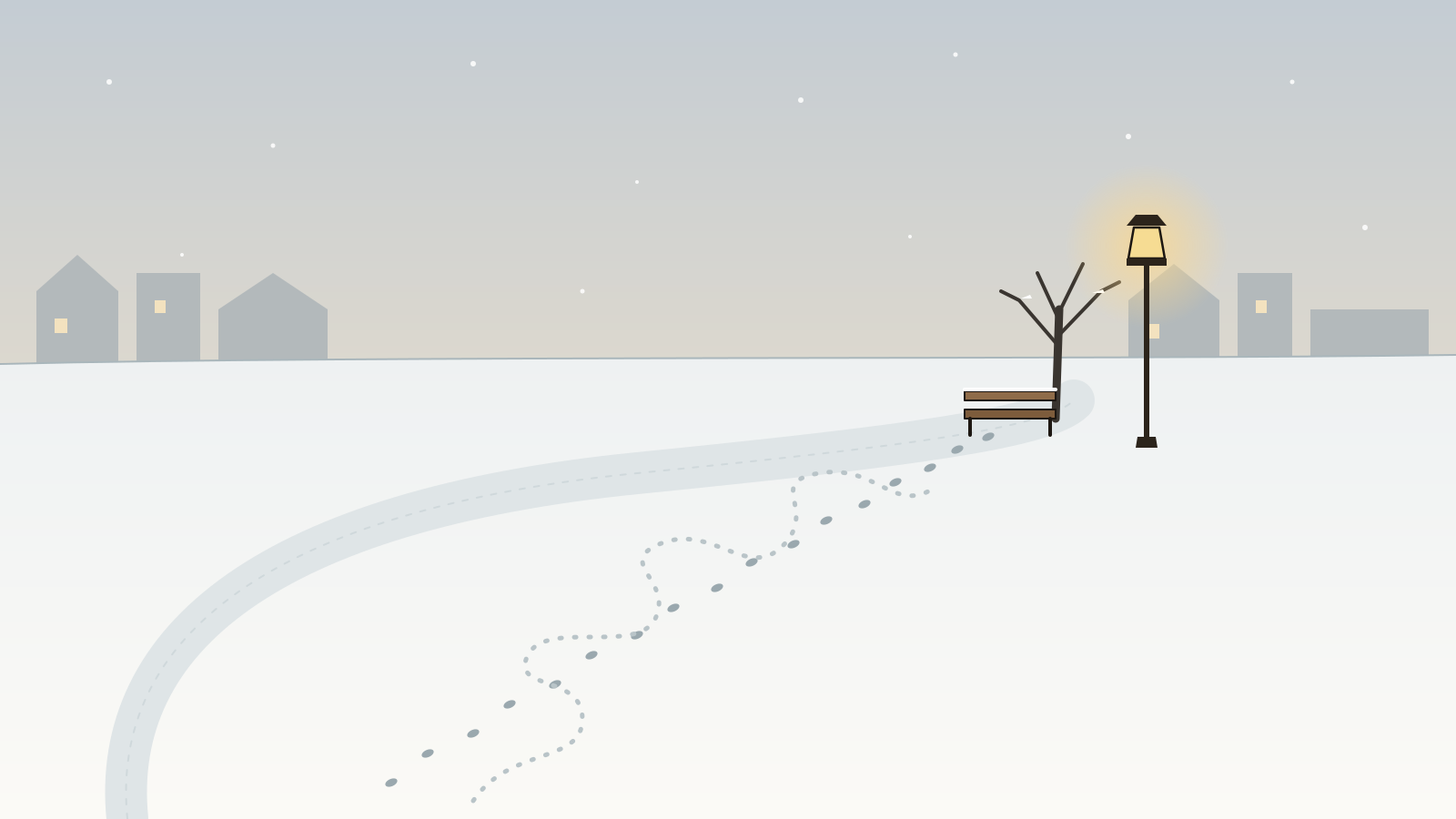
In Finland, when the first real snow of winter falls, some city planners do something lovely. They go out to the parks early in the morning, before the paths have been cleared, and they look at the footprints.
Under the snow, the neat paved paths have disappeared. Nobody can see where they’re supposed to walk. So people just walk where they actually want to go: straight across the corner to the bus stop, diagonally to the bakery, down to the bench by the water. By mid-morning the white park is crossed with dark lines, and nobody drew a single one of them.
Planners call them desire paths. They’re the routes people choose when nobody is telling them what to choose. And the wise ones use them: they build the new paths where the feet have already gone.
There’s a short line by the Spanish poet Antonio Machado, written more than a century ago, that every walker eventually discovers for himself:
Caminante, no hay camino, se hace camino al andar.
Traveller, there is no road. The road is made by walking.
This piece is about that kind of path. Not the paved one somebody drew for you. Not the impossible one you drew for yourself, with every step planned. The real one: hidden at the start, made step by step, and somehow obvious when you look back at your own footprints in the snow.
It brings together four quiet ideas that, put side by side, fit like the four points of a compass. Each one is simple. Together they make a life more peaceful, more honest, and much more playful.
The map you were handed
Most of us start out with a map we didn’t draw.
It comes from parents, school, films, advertising, the lads at work, the feed on our phone. It tells us what a man is supposed to want: the job title, the house, the car, the body, the number in the bank, the age by which each should be reached. It shows a tidy paved path through life, with signposts.
There’s nothing wrong with having a map. The trouble starts when the map and the ground disagree, and we argue with the ground.
North: see like a scout
In 1894, a French army officer called Alfred Dreyfus was convicted of selling military secrets to Germany. The evidence was thin: some handwriting that experts disagreed about, and a great deal of suspicion, much of it because he was Jewish. His fellow officers sincerely believed he was guilty. Every new fact was bent to fit. When a search of his home found nothing, they took it as proof of how carefully he’d hidden things. He was stripped of his rank in public and sent to Devil’s Island for life.
The following year, an officer called Georges Picquart became head of army intelligence. He shared his colleagues’ prejudices, and he had assumed, like them, that Dreyfus was guilty. But he noticed something that didn’t fit: secrets were still leaking, with Dreyfus locked away on an island. He followed the thread, and found another officer whose handwriting matched the original memo exactly.
His superiors told him to drop it. He didn’t. He was sent away to Tunisia, and later put in prison himself. It took more than ten years, but Dreyfus was cleared, and Picquart, the man who had been willing to discover he was wrong, ended up as France’s Minister of War.
There are two ways to hold a belief, and this story shows both.
The first is the way of the soldier. A soldier’s job is to defend a position. Evidence that helps his side is welcomed; evidence against it is attacked. Changing his mind feels like losing ground. Nearly all of us do this, most of the time, without noticing: about our politics, our past decisions, our marriages, our careers, ourselves.
The second is the way of the scout. A scout’s job isn’t to defend anything. It’s to come back with an accurate map. If the river isn’t where everyone thought it was, that’s not a defeat. That’s the most valuable thing he could have found.
The surprising thing is how good the scout’s way feels once you try it. A scout is curious instead of defensive. When something doesn’t fit, his first thought isn’t that’s wrong, but huh, that’s interesting. His sense of his own worth doesn’t hang on having been right. Looks like I was wrong stops being a wound, and becomes just news.
Programmers know this feeling well. When a program misbehaves, a good engineer doesn’t argue with it. The bug isn’t an insult; it’s information. The best debugging sessions end with a small laugh and oh, of course. That’s the scout’s laugh. It’s a lovely way to live.
A few scout’s questions to keep in your pocket:
- What would I expect to see if I were wrong about this? Then go and look.
- Am I asking “must I believe this?” or “can I believe this?” We demand proof for what we dislike, and accept almost anything for what we like.
- How sure am I, really? Not yes or no, but about seventy per cent. Then notice how often your seventies come true.
- If someone I disagree with said this, would I accept it?
Turn the scout’s eyes on your own life and something interesting happens: you start to see your own desire paths. Where does your attention actually go, when nobody’s watching? What do you find yourself doing on a free Saturday? Which conversations leave you more alive? The map says one thing. Your footprints, honestly read, often say another.
South: make peace with the edge
The second point of the compass is the one we explored in Four Thousand Weeks at the Kitchen Table: you are finite. Gloriously, completely finite.
You will never read all the books. You’ll never clear the to-do list, finish all the projects, reply to everyone, become all the people you might have been. The pile of things you could do is effectively infinite, and you are not.
Most of the misery of modern life comes from refusing this. We keep believing that if we just get a bit more efficient, a bit more organised, a bit more disciplined, we’ll finally get on top of everything, and then our real life can begin. So we wait for our real life, forever.
But here’s the turn, and it’s a gentle one. Once you truly accept that you can’t do it all, you’re free to stop trying. The impossible standard falls away. You can treat your list not as a debt to clear, but as a menu to choose from: what will I have, today, from all of this? Some things are unavoidable, of course. But far more than we admit is a choice.
And something else falls away too: the idea that one day life will be free of problems. It won’t. Life is a series of problems. The only real question is which problems you’d most like to have. A man who builds a small business will have the problems of a small business. A man who raises children will have the problems of a family. Those are good problems. They’re the shape of a life well chosen.
There’s an old engineering idea hiding in here. In The Computer That Knew What to Drop, the Apollo guidance computer survived not by trying to do everything, but by knowing what to let go when it was overloaded. A finite person who knows what to drop isn’t a failure. He’s well designed.
Peace doesn’t come from getting everything done. It comes from knowing, calmly, that you never will, and choosing anyway.
West: choose the few
If you can’t do everything, then what you choose matters enormously. That’s the third point of the compass, and it’s the heart of essentialism.
The essentialist way has three movements:
- Explore widely. Look around more than most people do. Read, wander, talk, try things, listen. Make space to think: a walk, a notebook, an hour with nothing scheduled.
- Eliminate almost everything. Use a strict test: if something isn’t a clear yes, it’s a no. Score an option out of a hundred on what matters most to you, and treat anything below ninety as zero.
- Execute the little that’s left, well, and make it as easy as possible to keep doing.
Notice the order. Wide first, then narrow. A scout explores; an essentialist chooses. Most people do the opposite: they narrow early, out of fear, and then spread themselves thin across the narrow thing.
Two items, surprisingly, are always on the essentialist’s short list.
The first is sleep. It isn’t a reward for finishing the work. It’s the thing that protects your best asset, which is you.
The second is play. Play is anything you do simply because you enjoy it: kicking a ball, building something pointless, singing badly, wandering a town without a plan. It isn’t a waste of time. Play widens what you can see, lowers stress, and lets the mind make connections that effort can’t force. A man who never plays loses the very faculty he needs to find a new path.
And remember the essentialist’s question about trade-offs. Not how can I do both?, but which do I want to go big on? That one question, asked honestly, will untangle more knots than any productivity system.
East: walk like a generous optimist
The fourth point is about how to walk once you’ve chosen. And here a single life says more than any theory.
In the 1970s, a young American with a year of college behind him went to Asia with a camera and stayed for most of the decade, photographing remote places. He rode a bicycle five thousand miles across America one summer. None of it looked like a career. None of it was on any map anyone would have handed him.
That wanderer was Kevin Kelly. He went on to edit the Whole Earth publications, and in 1993 he helped launch a new magazine about the future called Wired. In his late sixties he started writing down advice for his own grown children, short and plain, and it became a small book that people now press into each other’s hands. At twenty, his path was invisible. From seventy, it looks almost obvious. It was made by walking.
The spirit of that kind of walking is worth naming, because it’s rare:
- Optimism, as a practice, not a mood. Not believing everything will be fine, but believing that problems can be worked on, and that it’s worth trying. Over the long run, it’s the optimists who build things; pessimists are often right, and stay where they are.
- Small experiments. Don’t decide your whole life in your head. Try a version of it for a fortnight. Run the risk you can afford. Most decisions are doors you can walk back through.
- Be the only, not the best. Instead of competing to be the best at something crowded, follow your odd mix of interests until you’re the only person doing exactly what you do. That’s a path nobody else can block, because nobody else is on it.
- Generosity. Give first. Help people without keeping score. Listen properly, and when someone you love stops talking, ask is there more? Forgive quickly, mostly for your own sake. Choose being kind over being right.
- Patience. Good things tend to arrive slowly, and then all at once.
The fifth direction: play
Here’s what happens when you put the four together.
A man who sees like a scout isn’t afraid of being wrong. A man who has made peace with his limits isn’t crushed by what he can’t do. A man who has chosen a few things isn’t scattered. A man who walks as a generous optimist expects the path to reward him, and is kind along the way.
What do you call a man like that? Light. Curious. A bit mischievous. You call him playful.
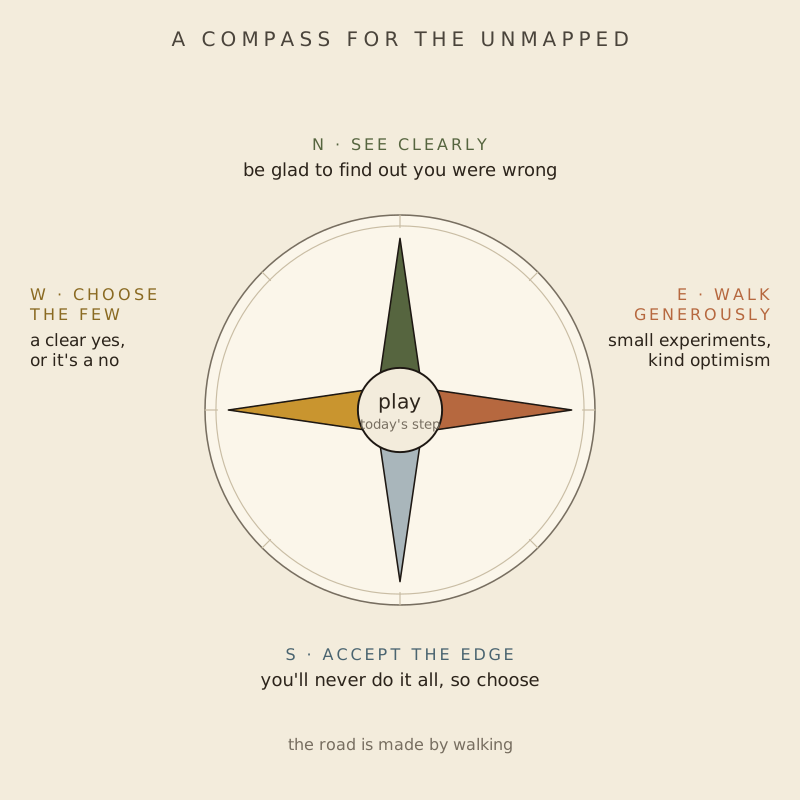
Play is what life becomes when the fear goes out of it. Plans become games. Mistakes become stories. A setback becomes a puzzle. You hold your goals the way a child holds a kite string: firmly enough to fly it, loosely enough to let the wind do some of the work.
Programmers have a beautiful tool for exactly this spirit. In git, the system most of the world uses to look after its code, you can create a branch: a copy of your work where you can try anything at all, with no risk to the real thing. If the experiment works, you bring it back. If it doesn’t, you simply delete the branch, and nothing is lost but an afternoon.
git switch -c try-it      # a safe place to experiment
# ...live it for a fortnight...
git switch main
git merge try-it          # it worked: keep it
# or
git branch -D try-it      # it didn't: let it go, no harm done
Most of life is far more branchable than we think. A new route to work. A class on a Tuesday night. A month without alcohol, or social media, or the car. A small business, run in the evenings, as in The Laptop on the Kitchen Table. A different way of talking to your son. Try it on a branch. Merge what works. Delete what doesn’t, without shame. The scout learns, the finite man chooses, the essentialist keeps only the clear yeses, and the optimist tries again tomorrow.
That’s how the hidden path appears. Not all at once, from a mountain top. One branch, one experiment, one honest look at your footprints at a time.
How the path becomes obvious
There’s a strange thing about paths made by walking: they’re invisible from the front and obvious from behind.
At the start you’ll feel unsure, perhaps a bit foolish. You’ll walk away from the paved path while everyone else is on it. You’ll make wrong turns. That’s fine: wrong turns are what scouts are for. You’ll come back with a better map.
But one day you’ll stop, turn round, and see your own line of footprints stretching back across the snow. And it will look so straight. So clearly yours. As if it could never have gone any other way.
That’s what the Finnish planners are looking for in the morning snow. Not the path somebody designed, but the one people actually needed. Your life has one of those too. You find it by walking.
A field notebook
A simple practice, in a small notebook kept just for this.
Every week, five short lines:
- I was wrong about… One belief, big or small, that met reality this week. Write it with a smile.
- I’m trying… The experiment on your current branch, and how it’s going.
- A clear no. One thing you declined, or dropped, to protect what matters.
- I played. What you did purely because you enjoyed it.
- I gave. Something you did for someone else, with nothing asked in return.
Once a season, read your footprints. Look back through your calendar, your bank statement and this notebook, the way the planners look at the snow. Where did your feet actually go? What did you keep returning to without being told? Those are your desire paths. Consider paving them: giving them proper time, a place in the week, a bit of money, a bit of seriousness.
Once a year, ask the four questions of the compass:
- North: What did I change my mind about this year?
- South: What did I finally accept I won’t do, and how did it feel to let it go?
- West: What are the very few things that are a clear yes for next year?
- East: Where am I being an optimist, and who am I being generous to?
Then go outside on the morning of the first snow, if you can, and walk somewhere you’ve never walked before. Not for any reason. Just to watch the footprints appear behind you.
You don’t need a perfect map. Nobody has one, and the ones they sell are mostly wrong. You need clear eyes, a peaceful heart about your limits, a short list of things you love, a generous spirit, and the courage to step off the paved path and into the snow.
Then walk. The road is made by walking.
Sources and further reading
- Wikipedia, Desire path (on Finnish planners and the first snowfall)
- Antonio Machado, “Proverbios y cantares” XXIX, Campos de Castilla (1912)
- Julia Galef, The Scout Mindset (2021), and her TED talk, Why you think you’re right, even if you’re wrong (the Dreyfus and Picquart story)
- Oliver Burkeman, Four Thousand Weeks (2021) and Meditations for Mortals (2024), summarised here
- Greg McKeown, Essentialism: The Disciplined Pursuit of Less (2014), notes by Graham Mann
- Kevin Kelly, Excellent Advice for Living (2023), at kk.org; his life at The Long Now Foundation and Wikipedia; and a reading by The Marginalian